
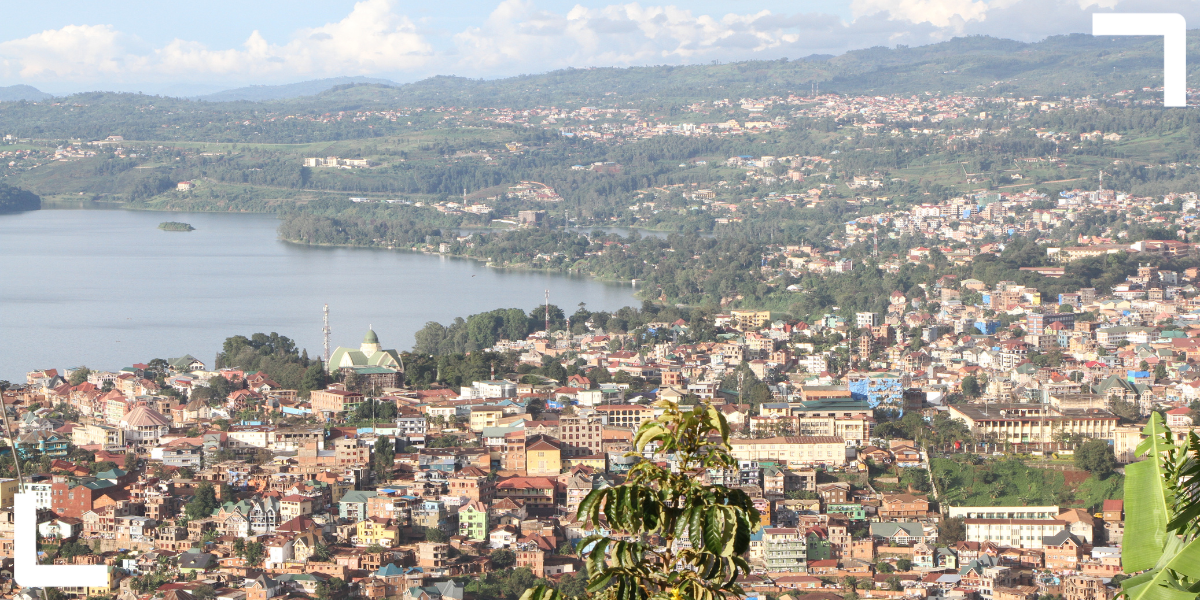
Home to around 1.3 million people, Bukavu in the Democratic Republic of Congo (DRC) faces significant and complex challenges related to governance, decentralisation, urbanisation and resource management. With the population expected to double by 2030 and triple by 2050, this rapid growth is only set to exacerbate the issues encountered by city residents – especially those living in informal settlements.
A new ACRC report by Emery Mushagalusa Mudinga, Aymar Nyenyezi Bisoka and Philippe Mulumeoderhwa Kaganda analyses how politics and urban systems shape – and are shaped by – these urban development challenges in Bukavu, across a range of domains.
Conducted between 2022-2023, the research and analysis do not cover developments in Bukavu since the city fell under the control of rebels from the Alliance Fleuve Congo/Mouvement du 23 Mars (AFC/M23) in February 2025. This new development in the political context may be the subject of future studies.
Legacies of colonisation and conflict
Divided into three administrative subdivisions, known as “communes”, and 20 neighbourhoods, Bukavu was a model of urban segregation in the 1950s, as a result of Belgian colonisation, with separate areas for white and black residents. When DRC declared independence in 1960, the city underwent a transformation of its racial composition and a gradual urban deterioration – accelerated by an influx of refugees from the Rwandan genocide in 1994.
A combination of rural insecurity and economic opportunities – linked to mineral resources – has fuelled population growth, informal construction and worsening living conditions in the city. Apart from the city centre, all of Bukavu’s neighbourhoods and surrounding areas are home to low-income and disadvantaged populations.
Understanding city and national politics
Politically, despite national stability since 2006, local governance in Bukavu prior to February 2025 remained marked by clientelism and inefficiency. Decentralisation was implemented in 2016 to provide provinces with resources for effective management, but low implementation rates of provincial budgets and resource distribution disparities hampered these efforts. Although some initiatives aimed at improving living conditions and legitimising the state were rolled out after 2019, challenges around governance, corruption and public resource management persisted.
As the capital of South Kivu province, Bukavu was critical to the national political settlement because of its role as a centre of political mobilisation. City power dynamics were marked by ethnic, political, geographic and professional divisions, with local elites able to influence political negotiations at a central level.
Navigating complex systemic challenges
Divided into three zones – the city centre, working-class neighbourhoods and informal settlements – Bukavu’s level of urbanisation has far exceeded forecasts of the 1957 development plan. This led to overpopulation and inefficient land use, with a transport system hampered by poor road conditions, and water and energy infrastructure inadequate to serve the city’s growing population. Issues of urban violence and other security problems were found to mainly affect residents living in less developed areas, while food insecurity is also high, with more than two in five households lacking access to healthy food.
The inability of municipal authorities to manage the city’s systems led to multiple non-state actors – including NGOs, local leaders and the private sector – playing an increasing role in the provision of essential services such as water, hygiene and sanitation, security and transport. Yet this multiplicity of actors created confusion and competition, without improving functionality.
Key insights from the urban development domain studies undertaken in Bukavu include:
Land and connectivity
Population growth, largely fuelled by rural migration, led to increased demand for housing and land. With the city confined to an area of just 60km2, this led to the fragmentation of plots in the city centre and outskirts, and rural residents occupying land unsuitable for building. The authorities subdivided new neighbourhoods to try to deal with this, but without subsequent adequate infrastructure development, resulting in a disordered urban landscape.
The research identifies eight key challenges within this domain: overcrowded housing in working-class neighbourhoods; vulnerability of low-income households to rising land prices and rents; more than 60% residents living on sites unsuitable for construction (exposed to risks of subsidence, erosion and flooding); land tenure insecurity; conflicts linked to land grabbing; damaging mismanagement of land revenues; obstruction or absence of roads in certain neighbourhoods; and the city’s isolation, resulting from poor road maintenance.
Safety and security
Many factors contributed to the insecurity experienced by Bukavu over the last few decades, including the influx of refugees following the 1994 genocide in Rwanda, overpopulation as a result of rural migration, the persistence of armed groups, the emergence of informal local security groups, inadequate salaries and high unemployment rates, to name a few. The limited capacity and capabilities within official security forces, along with issues related to land use – such as uncontrolled construction and deteriorating infrastructure – also contributed to this pervasive insecurity.
Neighbourhoods in overpopulated and underdeveloped areas of Bukavu were found to be most affected, where insecurity generally took the form of urban crime. Public places, including markets and large public squares, were also sites of permanent or sporadic insecurity in the city. While local security associations emerged in some areas to help address these issues, their success depended on them having legitimacy, covering a small geographic area, receiving material and financial support from residents, and having effective leadership.
Health, wellbeing and nutrition
Ongoing weakening of food supply chains made it difficult for Bukavu’s residents to access healthy food, especially for vulnerable groups. As many as 43% of households in the city were food insecure, mainly in the commune of Ibanda, where many families live in poverty and cannot afford sufficient, healthy food. There was also a severe lack of access to safe drinking water.
The high cost of and limited access to quality, healthy food items, along with a lack of time to prepare nutritious meals, led to increased consumption of highly processed foods. Rich in fats and sugars, these processed foods increase the prevalence of non-communicable diseases, such as obesity, diabetes and hypertension. Malnutrition among children and pregnant and breastfeeding women was also a serious public health problem.
Header photo credit: Action pour la Paix et la Concorde (APC). View of Bukavu over Lake Kivu, Democratic Republic of Congo.
Note: This article presents the views of the authors featured and does not necessarily represent the views of the African Cities Research Consortium as a whole.
The African Cities blog is licensed under Creative Commons Attribution-NonCommercial-NoDerivatives 4.0 International (CC BY-NC-ND 4.0), which means you are welcome to repost this content as long as you provide full credit and a link to this original post.
