

By Esther Thontteh, Damilola Agbalajobi, Olumuyiwa Adegun and Taibat Lawanson
Taxation is crucial for financing development. Attaining an equitable tax system depends on prudent policy formulation and effective administrative practices, aimed at generating revenue that benefits all of society.
Equitable taxation is about building fairer systems which align with a much-needed path to inclusive urban development. The Lagos property tax system can be improved to facilitate a win-win for all urban residents.
Operationalisation of the Lagos Land Use Charge
Land Use Charge (LUC) is one of the taxes in Lagos, derived from the Land Use Charge Act of 2018. This law consolidated all property and land-based rates and charges in Lagos State. Accordingly, the previously enacted tenement rates law, ground rents law and other similar property rates or charges ceased to apply to properties in Lagos State from 2018.
Over the last seven years, in operationalising the law, there has been an expansion of chargeable properties and liabilities to include vacant land and occupiers holding leases of over ten years, and even persons unlawfully in occupation.
Abrupt increases in property tax bills to residents because of the LUC provoked widespread public discontent, including protests. Disparities between governmental revenue goals and public perceptions of fairness and affordability also became evident. This underscores the fact that even well-framed legislation must account for socioeconomic contexts and harness public support to ensure effective implementation in cities. The LUC law provides for the revision of property values every five years, hence the need to revisit the assessment processes, including reliefs and technology for equitable taxation.
Inequitable assessment processes
The principle of an equitable tax system revolves around the notions of progressiveness, neutrality, transparency and accountability. A system with shortcomings in these areas, such as the one in Lagos, therefore requires re-evaluation.
For instance, LUC assessment in the state is currently based on the capital value (assessed market worth) of the property. However, land professionals at different forums, such as the 2018 University of Lagos Land Tax Conference, claimed that assessment should be based on annual rental value, not market capital value. As such, assessing the annual LUC rate based on the market value is inequitable, as the property owner may not receive the market value annually.
This contradicts Adam Smith’s seminal position that taxation principles should prioritise equity (fairness in burden distribution), efficiency (minimising economic distortion), sufficiency (raising adequate revenue) and simplicity (ease of understanding and administration) for a just and effective system.
Re-evaluating relief mechanisms
Occupiers exempted from paying an annual LUC on the Property that they occupy or reside include the following:
- Religious bodies;
- Libraries;
- Public cemeteries and burial grounds;
- Palaces of recognised traditional authorities; and
- Properties owned by aged people (70 years and above), retirees, and physically challenged people (subject to application and approval).
The question is: do these reliefs capture the vulnerable citizens who may have lost their source of livelihoods? Do they reach informal communities, which are often inundated through flooding or razed by fire, and live precariously in areas without road infrastructure and basic social amenities? How many urban citizens exempted from tax are aware that they need to apply for such relief when necessary?
As of 2024, Lagos generated over 14 billion Nigerian Naira (approximately USD 9.5 million) annually from LUC revenues.
However, the current property tax system tends to exclude informal communities where social amenities are regarded as privileges rather than rights. ACRC’s theory of change identifies committed political elites, formal–informal reform coalitions, enhanced state capacity and mobilised citizens as essential preconditions for transformative urban reform. In line with these pillars, the property tax system should avoid excluding informal communities, prioritising revenue extraction over service delivery, and disincentivising marginalised residents from civic mobilisation.
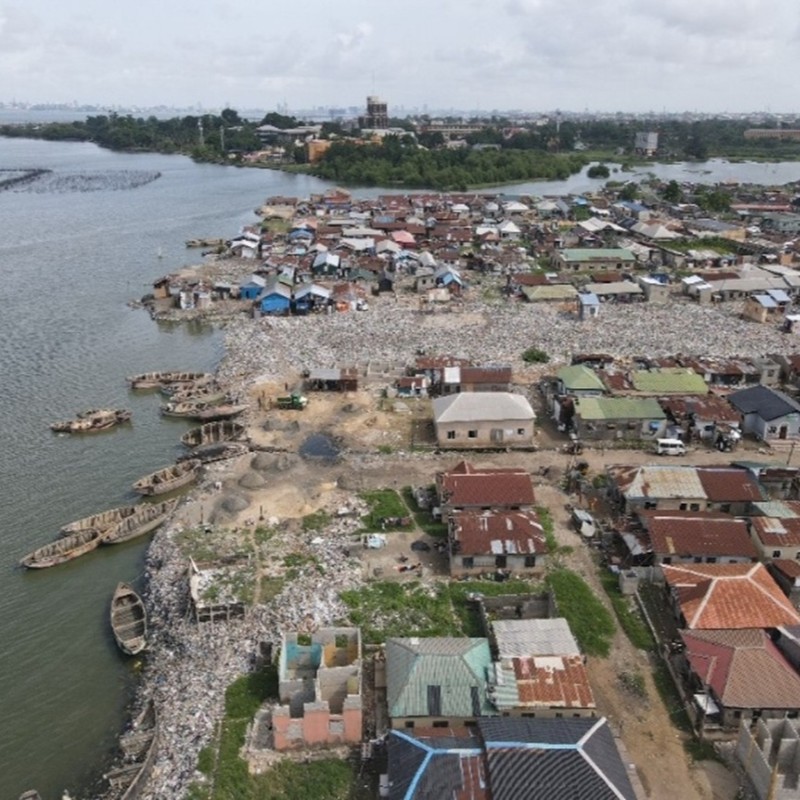
An aerial view of Bariga, one of several marginalised communities in Lagos. Photo credit: Bola Oguntade – Urban Lab Summer School, 2025
Technology, taxation and inclusive urban development
Digital tools and technology hold promise for property taxation, though caution is required in this regard. In June 2025, Lagos unveiled the digital house numbering system to enhance property identification and more efficiently capture more properties within the tax net.
The digitisation of houses aligns with so-called “smart city” ideals in the world-class city vision of the Lagos State government. While this initiative has a lot of potential in terms of service delivery within the city, it is concerning that it might impose additional financial burdens on urban residents. Genuine urban transformation is usually enabled by the willingness of residents to pay for value-added public services and infrastructure.
We argue that leveraging modern technologies (such as artificial intelligence and geographic information systems) for property tax reform can help catalyse inclusive urban development if it adopts the following principles:
> Valuation with local nuance: While market value is standard for property taxation globally, its application in Lagos must be nuanced in the context of slums and informal settlements, incorporating local realities. For example, women and vulnerable groups should be supported with policies that guarantee tenure security and fair treatment.
> Simplified assessment process: For smaller properties, especially in informal or low-income areas, the state should consider simplified, area-based assessments initially – with clear pathways to move towards full market value as development progresses and data improves, reducing complexities for both assessors and property owners.
> Unlocking dead capital: By utilising an inclusive approach that does not increase burdens on vulnerable residents within informal communities, “dead capital” can be incrementally unlocked. This is also crucial to the economic empowerment of low-income residents.
> Linking taxes to services: Demonstrating tangible benefits for taxpayers, especially in cities, fosters compliance and strengthens trust.
Pointing the way to property tax reform in Africa
At the recent African Real Estate Society Conference (AfRES), held in Lagos in September 2025, professionals in the sector examined how taxation can be reformed to better serve citizens and governments. The discussion highlighted several persistent challenges and identified some key steps forward for African cities:
1. Reliable cadastral and geo-informatic systems are still lacking in many places. Without accurate records of who owns what, governments cannot tax land fairly or efficiently. Digital platforms have improved matters, but political will and enforcement remain critical.
2. Protecting vulnerable groups is important. Rural communities, women, retirees, informal settlement residents and other marginalised groups must not be burdened with unpredictable charges, while wealthier landowners exploit loopholes to avoid paying their fair share. Flexible payment systems, such as spreading taxes across the year can also ease the burden on disadvantaged groups.
3. Stronger vacant land taxation and mechanisms to capture rising land values generated by public investments are recommended to tackle speculative landholding. All these need institutional reforms, including improved coordination across relevant government agencies and consistent enforcement.
The way forward
In conclusion, property taxation is one of the most promising yet underused tools for development in African cities. It is not only a technical exercise, but also a political and social endeavour. Done right, it can generate sustainable revenue, promote efficient land use and advance equity and inclusion. Done poorly, it risks deepening socioeconomic inequalities and eroding public trust.
The way forward lies in combining data-driven systems, inclusive policies and strong institutions to create tax systems that serve both people and cities. Reforming property tax system is not simply a fiscal necessity; it is a pathway to more inclusive, resilient and prosperous urban futures in Lagos and across Africa.
Header photo credit: peeterv / Getty Images (via Canva Pro). African megacity Lagos, Nigeria.
Note: This article presents the views of the authors featured and does not necessarily represent the views of the African Cities Research Consortium as a whole.
The African Cities blog is licensed under Creative Commons Attribution-NonCommercial-NoDerivatives 4.0 International (CC BY-NC-ND 4.0), which means you are welcome to repost this content as long as you provide full credit and a link to this original post.
