
By Adewumi Badiora, ACRC Lagos action research lead and senior lecturer in the Department of Urban and Regional Planning at Olabisi Onabanjo University
Nigeria is urbanising at a remarkable speed. Some of the world’s fastest growing cities are in the west African country.
With the current rate of urbanisation, Kano, Ibadan, Abuja and Port Harcourt will surpass the 10 million inhabitants mega city threshold by 2050. According to United Nations estimates, Lagos will be the largest city in the world by 2100, accommodating more than 88 million people, up from the present population of about 25 million.
The rapid urbanisation and other issues, such as climate change, limited public finance and extreme poverty, are putting pressure on the government to provide better basic public infrastructure, especially in informal settlements.
Streetlighting is one area of public infrastructure where there is a clear need, and potential, for improvement.
Streetlighting plays a crucial role in public safety and security, and it promotes inclusive social and economic development by boosting local commerce, street businesses and community engagement.
Conventional grid-based streetlights and other technologies like LED lights powered by solar energy have been installed in parts of Nigeria but are still lacking in many cities.
I have been researching various aspects of urban and community safety in Nigeria, particularly in the country’s south-west. I currently lead the African Cities Research Consortium safety and security domain action research in Lagos.
I co-authored a recent research report about the condition of streetlights in Lagos. I interviewed 17 key informants in a bid to understand the provision, challenges, quality and impact of streetlighting in Africa’s foremost mega city. Respondents included residents and community associations, state agencies, private sector companies, and nongovernmental agencies.
We found that streetlight provision by the state has been orientated towards elite neighbourhoods, while households in disadvantaged settlements have less access.
Nevertheless, low-income communities across the city have come together to drive progress. They have enabled residents to achieve some level of streetlight infrastructure in their neighbourhood by working with the local government, civil society organisations and NGOs.
We argue that solutions will only be found through inclusive engagements that push against established approaches to infrastructure development.
Multiple paybacks of streetlighting
Research was conducted in three selected communities: Ilaje-Bariga on the Mainland, Brazilian Quarters on the Island and Ajegunle-Ikorodu in the peri-urban area. The three communities have either past or ongoing streetlight projects being delivered via sponsorship or collaboration between the Community Development Association, state or nonstate institutions.
Economic and social benefits were particularly prominent. Residents feel safer going out after dark when streets are well lit, while workers feel safer walking to and from their homes early in the morning and at night.
Businesses on newly lit streets have seen increased revenue as a result of vendors and traders being able to operate for longer after nightfall.
A previous case study established that extending trading times beyond daylight hours could add tens of thousands of working hours daily to the economy.
A respondent commented: “Policing work is now better in the night and we do not need to rely on battery-powered torchlight while on street patrol or checks.”
Another added: “We used to have cases of robbery, but the streetlight makes everywhere lit like daytime … the hoodlums are no longer able to perpetrate their act.”
Hurdles of streetlight provisions
Some obstacles remain, however. Our research uncovered many reasons as to why streetlight projects are not long-lasting or are unsuccessful. Limited budgeting and politically driven procurement are key challenges.
We found that the high costs and limited state budgets mean that certain areas of the city are prioritised and other areas neglected. The ruling class receives more political and economic support.
Across the three communities researched, the average cost of installation of one solar streetlight pole is USD 200-800, compared to USD 1,150 for a conventional grid powered streetlight. The difference in operating costs is where the economics of solar powered, compared to conventional, streetlighting becomes most compelling.
Politically driven procurement spotlights the need to favour cronies on the selection, awarding and implementation of streetlight infrastructure. Projects are awarded in favour of individuals (usually party members and not necessarily an expert) in exchange for political support.
The lack of technical expertise at the local and state levels remains a critical barrier, according to our study. This is displayed in poor procurement processes, infrastructure maintenance issues and inefficient use of limited public funds.
Because of corruption, the full value of project allocation is rarely received by suppliers. As one respondent explained: “In most cases, the money allocated for projects does not get to us. There are bottlenecks here and there that will drain off most of the project fund.” This leaves limited capital to deliver quality infrastructure and streetlight projects are poorly delivered or abandoned before completion, for want of funds.
Other streetlighting projects are abandoned because succeeding regimes refuse to continue predecessor projects.
There is also the challenge of vandalism and theft involving streetlight equipment. There have been situations where “area boys” – Lagos street gangs – restricted streetlight installation and where equipment parts were stolen.
Overcoming the obstacles
The solutions can only be found through inclusive engagements. Our study recommends the following steps:
- Involve a wide range of players, particularly local communities, in planning and delivering streetlighting.
- Build an enabling environment for private-sector-led renewable solutions and investment in sustainable lighting technologies, such as LED lights.
- Create a robust regulatory framework to produce sustainable lighting technologies locally.
- Improve state budget and investment funding for streetlighting.
- Develop capacity in the public sector to plan, design, finance and deliver projects.
- Support low-income neighbourhoods and informal communities.
- Separate political, personal interests from good governance and ensure transparency in the procurement process in practice.
So far, the large-scale initiative involving the deployment of over 22,000 solar streetlights has engaged with residents in areas like Ikotun, Alausa, Ketu, Kosofe, Marina, Lekki and Surulere. Community feedback on the safety and environmental benefits has been integrated into the project. The project adopted LED lighting, which is more cost effective and energy efficient.
This article is republished from The Conversation under a Creative Commons license. Read the original article.

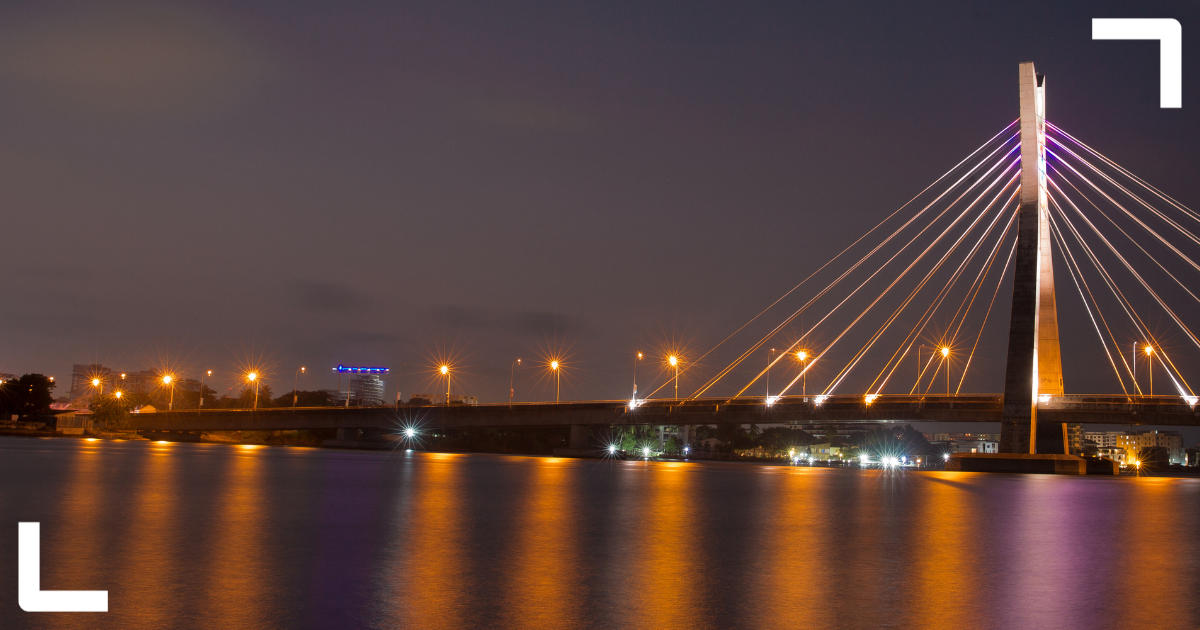
Header photo credit: James Enyi / Getty Images (via Canva Pro). Streetlighting on the Ikoyi Link Bridge in Lagos, Nigeria.
Note: This article presents the views of the author featured and does not necessarily represent the views of the African Cities Research Consortium as a whole.
The African Cities blog is licensed under Creative Commons Attribution-NonCommercial-NoDerivatives 4.0 International (CC BY-NC-ND 4.0), which means you are welcome to repost this content as long as you provide full credit and a link to this original post.
