
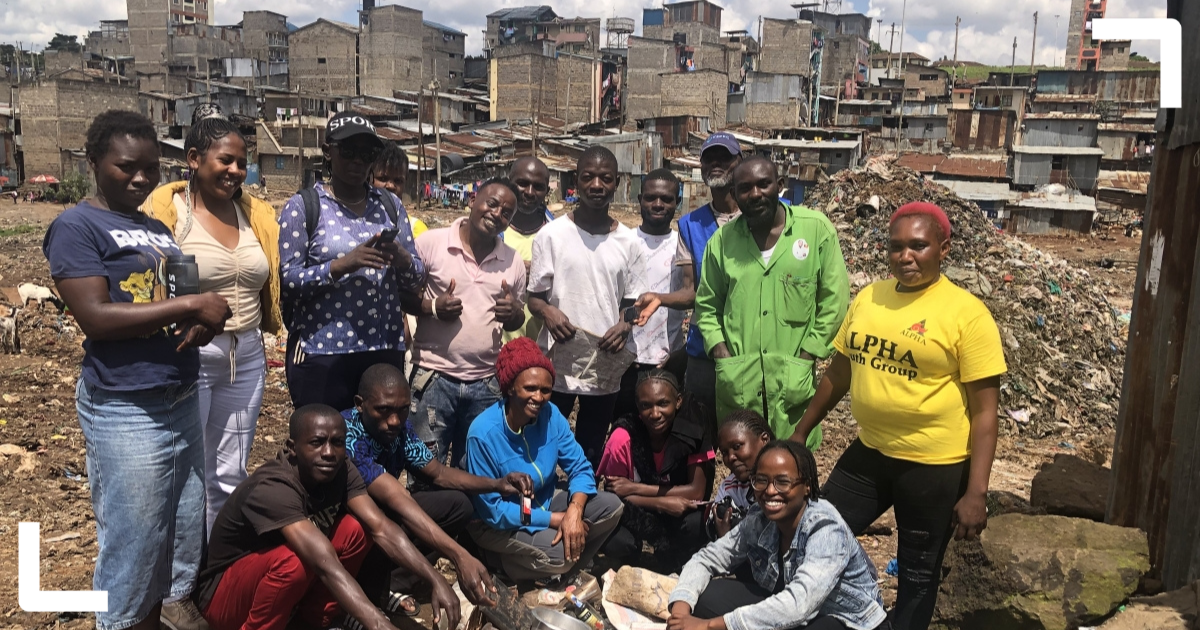
Informal waste workers are the unseen backbone of Nairobi’s waste value chain. Moving from households to dumpsites, then to recyclers, farmers, businesses and other end users, they keep solid waste flowing – filling the gaps left by formal systems.
In ACRC’s initial foundation phase research, we identified inadequate solid waste management as a key systemic challenge in Nairobi, which particularly impacts the city’s informal settlements. Waste from other parts of the city often ends up dumped in lower income areas, creating environmental and health hazards for residents.
Taking this forward, Nairobi’s community research team lead, Wavinya Mutua, set out to better understand the dynamics of solid waste management across the Mathare subcounty. Rather than relying on traditional methods, the goal was to generate a body of community-held knowledge about waste flows in Mathare. Informal waste workers planned, collected and analysed the data, before determining next steps.
A new research report explores the creation of the community-led research strategy, the multiple informal actors involved in the different stages of Mathare’s waste value chain, the crucial political dynamics underpinning the operation of dumpsites and holding grounds, and recommendations for further research to expand knowledge of Nairobi’s informal circular economy.
Key takeaways from the research report include:
1. Community knowledge is a vital research tool for understanding how urban systems operate. It allows for the complexities of Mathare’s waste value chain to be understood in ways that conventional datasets miss and ensures that those directly affected by urban issues are actively involved in the research process. Employing waste workers as co-researchers and learning from their lived experiences creates a far more accurate picture of local dynamics and how different systems interact.
2. A huge gap exists between waste generation and removal in Mathare. Of the 169 tonnes of waste generated daily in Mathare, only 57% is collected. Most of this collected waste ends up in the subcounty’s holding grounds, before eventually being transferred to the Dandora landfill. Waste collection alone therefore does not remove the environmental burden borne by the subcounty. The remaining 43% of waste ends up flowing into illegal dumpsites or “dumping hotspots”, often clogging drainage systems, sewers and the Mathare River.
3. An informal waste industrial complex has emerged to fill gaps in government services. Although not sufficient to deal with the scale of the problem, the informal waste system acts as a critical substitute for municipal services and provides thousands of waste workers with low-level incomes. It includes a diverse range of actors – from waste pickers to aggregators – who drive an informal circular economy by reclaiming and recycling materials usually ignored by formal systems.
4. Government waste policies are often counterproductive, prioritising compliance over infrastructure. In treating illegal dumping as a compliance issue instead of a service failure, the Nairobi City County Government (NCCG) tends to penalise informal waste workers, rather than addressing deficits in its waste management infrastructure. The government effectively punishes these informal workers for what can be understood as rational adaptations to a persistent, systemic issue.
5. Informal settlements bear the burden of Nairobi’s broader waste issues. Waste flow dynamics are complex and heavily influenced by administrative boundaries and cross-border movements. Valuable commercial waste from wealthier areas of Nairobi flows into Mathare’s dumpsites, leaving the informal settlement to manage large volumes of waste without the necessary financial or operational support from the city.
Building on both ACRC’s foundational research in Nairobi and the community-led solid waste research captured in this report, an action research project led by SDI Kenya is currently underway in Nairobi’s Mathare informal settlements – aimed at improving holistic waste management and establishing productive public spaces.
Header photo credit: Nairobi co-research team.
Note: This article presents the views of the authors featured and does not necessarily represent the views of the African Cities Research Consortium as a whole.
The African Cities blog is licensed under Creative Commons Attribution-NonCommercial-NoDerivatives 4.0 International (CC BY-NC-ND 4.0), which means you are welcome to repost this content as long as you provide full credit and a link to this original post.
