“Sustainability for us would mean leaving behind capability and capacities, not dependency.”
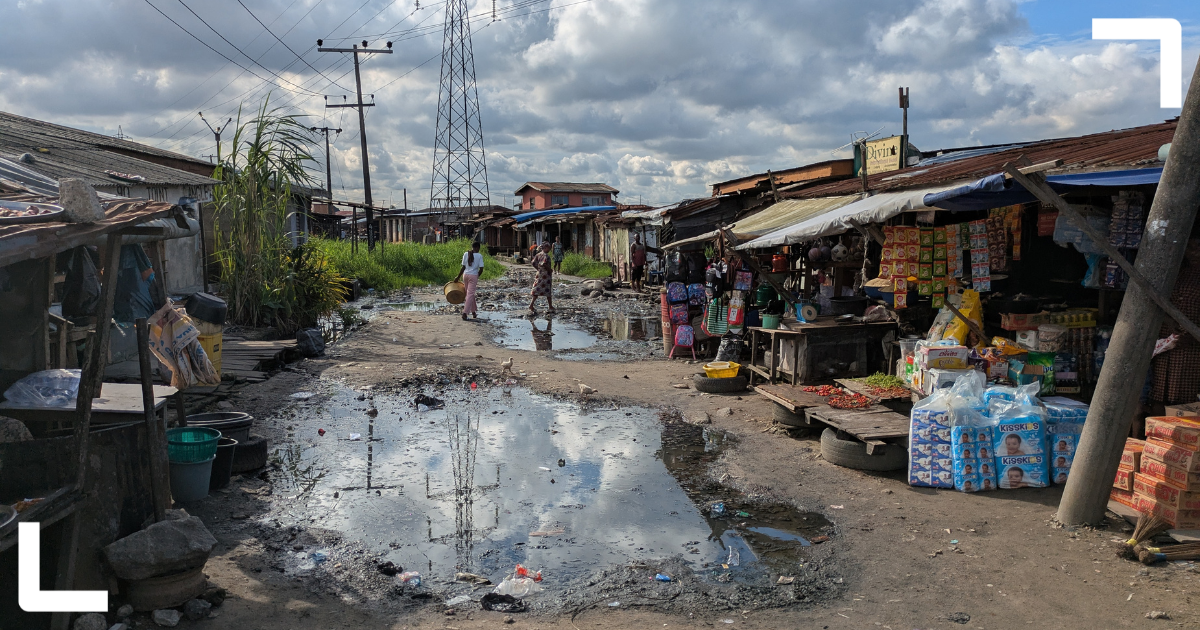
In the informal settlement of Okerube in Lagos, the community faces significant challenges in accessing clean water and sanitation, which disproportionately impacts women and children. An ACRC action research project is aiming to address these issues through establishing a sustainable, community-driven social enterprise model.
In this podcast episode, Deji Akinpelu is joined by guests Temilade Sesan, ACRC Lagos city manager, Funmilayo Daniel, a woman leader from Okerube community, and project co-leads Oluwaseun Muraina and Rasheed Shittu. They discuss the importance of building trust with the community, harnessing existing women-led structures to advance water, sanitation and hygiene (WASH) solutions, and supporting residents to advocate for their rights, so they can actively shape their community’s future.
Highlighting how community-driven initiatives like these can challenge urban inequality – by strengthening the capacities and capabilities of residents, and advocating for greater representation of informal settlements in urban planning – they also talk about the need for collaborative planning and community ownership, to ensure sustainability over the long term. Looking beyond Okerube to other informal settlements in Lagos, they conclude by talking about what a just and sustainable future would look like for these underserved areas.
> Read more about ACRC’s work in Lagos
Deji Akinpelu is co-founder of Rethinking Cities, an advocacy group working on urban development issues in Lagos, and part of the ACRC Lagos uptake team.
Temilade Sesan is a social development researcher and ACRC’s city manager for Lagos.
Funmilayo Daniel is a woman leader from the Okerube Water Committee in Lagos.
Oluwaseun Muraina is a doctoral candidate at the Centre for Housing and Sustainable Development, University of Lagos, and co-lead of the ACRC WASH action research project in Lagos.
Rasheed Shittu is the founder and executive director of the Shantytown Empowerment Foundation (SHEF) and co-lead of the ACRC WASH action research project in Lagos.
Transcript
The full podcast transcript is available below.
Read now
Deji Akinpelu Welcome to the African Cities podcast, brought to you by the African Cities Research Consortium, ACRC. Today we’ll be taking a closer look at how everyday communities are driving real change in water sanitation and hygiene, known as WASH, in the city of Lagos here in Nigeria. Our focus is on the Okerube community, one of the action research sites under the ACRC’s Lagos portfolio. This episode will explore how academic research connects with grassroots action and how communities are reclaiming local governance and how sustainable planning is taking shape from the ground up. With me on today’s episode are four amazing guests, who have all played key roles in this journey so far. I will allow them to introduce themselves. First, Dr Temilade, kindly introduce yourself.
Temilade Sesan Hello, everyone. My name is Temilade Sesan. I am the city manager for ACRC in Lagos.
Deji Akinpelu Thank you for being here. So let us have Mrs Daniel Funmilayo, a woman leader representative from the community. Mrs Daniel, can you please introduce yourself?
Funmilayo Mulikat Daniel I am Mrs Daniel, the women leader from Okerube water committee.
Deji Akinpelu Thank you for coming. Okay. Next is Seun. Please, can you introduce yourself?
Oluwaseun Muraina Thank you. Good morning, everyone. My name is Oluwaseun. I’m a doctoral candidate at the Centre for Housing and Sustainable Development. I am also the co-lead on the WASH project at Okerube.
Deji Akinpelu Thank you. Followed by Mr Rasheed.
Rasheed Shittu So my name is Rasheed Shittu, the executive director of Shantytown Empowerment Foundation, SHEF, the professional support organisation to Nigerian Federation, Slum Dwellers International, SDI, affiliates, also the lead on the ACRC WASH project in Okerube community under Oluwaseun.
Deji Akinpelu Great, thank you to everyone for joining us. So we’ll just get it all started. Temilade, let’s start with you. What made Okerube such an important site for the ACRC project? And what does its story reveal about urban inequality in Lagos?
Temilade Sesan Thank you very much and thank you again for having me on this really important conversation. So ACRC really is all about demonstrating through what we call exemplar projects and how communities that have been historically overlooked in urban development can really lead the way in helping us to rethink and reimagine what a good African city should look like? You know, what is that definition of a good city, a good society? Hint, the answer really is, you know, a city that carries everyone along in development and leaves no one behind. And Okerube is one such community. Okerube, if you’ve been there, I have had the privilege of being there several times. It’s got great social, cultural, economic, even political capital, right? But it’s really on the fringes, right? In terms of services and infrastructure, like water and sanitation, which is one of the many wicked problems in the community that, you know, ACRC has chosen to start with. And what does it say about our society, you know, and urban inequality? The second part of your question. I think that Okerube and, you know, similar communities, I think that they hold up a mirror to who we are as a society. I think they show us how short-sighted we are and how inequality really is an unproductive strategy, if we can call it a strategy. So just imagine, I’ll give a thought experiment here. Imagine for a second that tomorrow there’s a cholera outbreak in Okerube, which is in one of the most populated, maybe even the most-populated LGA in Lagos, Alimosho. That there’s a cholera outbreak in the area due to the inadequacy of WASH facilities, what we’re trying to address. The ripple effects are going to be enormous, schools may be closed, travel advisories will be issued. We’ve seen advisories being issued for even, even less, shall I say consequential, occurrences, you know, investors will be wary. You have things like shares dropping, share prices and things dropping, in other words like, you know, the big big dreams – in Lagos, we like to say big big things, which is after big big things – but the big dreams that we are chasing as a city would be severely threatened by this seemingly humble and simple you know thing that is inadequate water and sanitation in the city. So it just shows that inequality does not pay. At the end of the day, it does not pay anyone. And if it doesn’t pay anyone, then it doesn’t pay everyone.
Deji Akinpelu Thank you very much, that was quite insightful I must say. Yeah, so let’s hear from the community side directly. So I’ll be moving on to Mrs Funmilayo. So Mrs Funmilayo, can you please paint a picture of what everyday life looks like in Okerube, especially around water and sanitation? What has been the challenges so far?
Funmilayo Mulikat Daniel The Okerube community is a place here that is highly populated and the population is increasing on a daily basis due to the newly constructed road in the area. But unfortunately, as the community is growing, the issue of water and sanitation is becoming larger. Water and sanitation are major issues in the Okerube community. When people wake up in the morning, the first thing they move for is water to start the day’s activities and in the process of doing that, since they wake up early, the people that give free water, the few of them that give free water, they are not set to come out to give them and the houses where they have to go and fetch the water, where there are water vendors, it’s about five to eight houses, far away from the users. And at that point, when our women and children, when they go to fetch water, looking for water around, they are victims of being attacked by miscreants in the community. And we all know that the provision of potable water gives way to sanitation and good health. Without water, there’s nothing, we cannot be talking of sanitation. Frankly speaking, Okerube is currently experiencing bad sanitation due to lack of water. And most houses don’t have clean environments, resulting to water-borne diseases. Unfortunately, the community is not pushing enough to get water and sanitation. So the CDA (Community Development Association) is purely funded by the residents. And the focus is not for them to be able to pay for the security charges, the maintenance of electricity, and some self-help projects that does not require intensive expenses. This is because even majority of the residents, they don’t believe that it is their responsibility to do that. They are waiting for government. Government is not forthcoming. And this nonchalant attitude has led us to this level. Even the development levy, the levies that we normally collect monthly, the people don’t pay. And there’s no legal backing for the CDA to be able to get their money from the residents. And that is another challenge that we have. You have to use appeal. You appeal to them to pay the little money they want to pay. And when you don’t enforce anything, you don’t want to enforce, our people will not even take it seriously. So that is the challenges that we have. We are just hoping and hoping that there should be community development awareness campaign among our people and then there should be a legal way from government for us to be able to collect our levy. Then if that’s the goal, we’ll be able to get what we want.
Deji Akinpelu Okay, I’ll come back to you, Mrs Funmilayo, again. Right now, I’d like to move to Mr Rasheed who is the project lead on this. Mr Rasheed, so far, what are the key activities in trying to address this issue? What are the activities that have been carried out in Okerube and how has the reception been?
Rasheed Shittu Yeah, thank you so much. It’s a pleasure to be part of this podcast with regards to the WASH project in Okerube. Well, basically, since the inception of the project, the activities that we’ve been able to carry out in Okerube, one, we visited the community with the ACRC team from Manchester across all of the African cities. And there was a high level of enthusiasm from the community to receive the large team of ACRC and also the project itself. And again, we went around the community to visit the proposed land site for the hub, where the toilets and the borehole and the bathroom infrastructure, under water and sanitation. We visited the site, proposed site, with the ACRC team, with the community representatives. Also, one of the activities that we’ve been able to carry out was that we did a pre-project introduction in the community in ensuring that we are able to at least give the community an insight to the project that we intend to implement in their community and also we did the main project introduction in the community to be able to formally launch the project. And which, with regards to the reception, yeah, there was a high level of acceptance from the community during the project introduction and also joining the main project introduction, which is positive and we aim to ensure that the projects empower the women in the community and also key governance actors, to be able to improve water and sanitation services delivery in Okerube community. And also, there was a good acceptance from the local political appointee, which is the honourable councillor that is serving urban in Okerube Ward B, under Igando-Ikotun LCDA. Which also, there was the reception from the Lagos representative that attended the main launch of the project, and that would definitely address the challenges, the community phase in terms of water and sanitation, which also will serve as a learning space or a learning centre for all other informal settlements and slum communities that we work with in the city of Lagos.
Deji Akinpelu Thank you very much. It is good to hear that there are other stakeholders like government agencies and government appointees also participating in the project so far. And now to you, Seun. You also, you are a co-lead on this, so, okay. Okerube project, from what I gathered, was considering a very interesting approach in solving the WASH challenge in the community, using a social enterprise model rather than the traditional aid approach. Why this direction?
Oluwaseun Muraina Thank you. So the decision to adopt this social enterprise model it came about, or emerged from years, I’ll say years, of learning that the benevolent and the purely aid-driven projects often fail or collapse once external funding ends. And the same also applies to government provided infrastructure that hasn’t exactly put in the proper manmade frameworks increase. And so this persistent problem in these communities have often come from weak financial governance structures. So the first thing we did in Okerube was to, just like Mr Rasheed mentioned, there were a lot of preliminary activities, right? And the first thing we did was to know what currently exists and understand the people’s everyday realities, right? Some of things we wanted to find out: where the facilities, the services are available, you know, the mode of operations and the management existing. And what we found that was we noted was that the WASH interventions in this community have mainly been benevolent-based, you know, provisions, many times although they rely on government projects or charity. But the situation where what is available are meant for coming out. So we started to see that these things have not been sustained over time. For example, on toilet facilities, right, we noted one that was provided by the senator representing that district, another provided by the government, and another that’s privately owned, but mainly for commercial users. One of these three toilet facilities, especially the one provided by senator, you know, is currently non-functional. And another one, the one that’s provided by government has been taken over by an individual. And then the last one, of course, that’s privately owned for commercial users, where people have to pay tokens to access it. So we’re seeing situations where there is abandonment, there is non-functionality, and then we know what’s being meant for communal use that they’re taking over by an individual because proper structures have not been put in place, even with the government. And on the other hand, we’ve also realised that these residents are paying inflated prices for water. Of questionable quality, water that is not even potable, just to meet their daily need, and they are paying to unregulated water vendors who they have to rely on to provide this water. So, having analysed [inaudible] on ground is why we are proposing a more sustainable model, which we believe is going to be community-driven, of course, and which is in the form of this social enterprise model, so that we bridge the gap, and then they are able to move from of dependency to more self-reliance. So what is the social enterprise model? It is a model that is often adopted to address specific challenges and where a substantial portion of income generated through the sale of goods or services are then clawed back or reinvested into expanding the enterprise. And in this case, rather than this community solely relying on maybe donations or grants, they’re able to generate income that helps them to maintain this facility. So in form of [inaudible] in the form of remuneration for people who will be managing, you know, all of that. So that even when after long after we are out, this project has ended, these facilities are maintained long after this phase and then basically. So, of course, they need the greater details of it to still be fleshed out because there’s still a phase where we have to do community profiling and mapping to determine the exact needs of this community. But at least this is what we are proposing, a sustainable model. And every other thing we’re still planning.
Deji Akinpelu Thank you for that very in-depth explanation to the model being adopted for the programme. I’d like to move to Mrs Funmilayo, you’re a woman leader in the community and I would just like to know what has been the role being played by these women so far during this project and what are the possibilities that you see coming your way as a community, particularly as women?
Funmilayo Mulikat Daniel The role that women have played, they are numerous. They are numerous. Number one, the volunteering spirit of the Okerube Water Committee to work as a team is the key factor that plays a very vital role in shaping these initiatives. The spirit of unity in us. And we have been able to reach out to community members, creating awareness to the youth, to the market women, political office holders, advocating for the support of this initiative. And also, we hold our regular meeting, brainstorming on how to meet the initiative resources. And again, by active participation on all the programmes that are on ground for the initiative. That is the work that we have been doing. Now, we are hoping that with all this put in place, we will get where we are going. Thank you.
Deji Akinpelu Oh, thank you very much for that, your response. And still on the issue of gender, Dr Temilade, from your own research lens, how do you see gender shaping the outcome of this particular project?
Temilade Sesan Okay, thanks for that question. So I think one of the things that really excited me at the start of this, you know, while we were even shaping this proposal led by Mr Rasheed, was really this woman-led lens, because it is absolutely central to what we’re trying to do here. Women and children, you know, are traditionally the custodians of water provision, water access, I mean in households and communities here. So that’s something that you would write in like a research paper, right? In an academic paper. But what does it really mean in practice? I mean, for me, I do have lived experience of this. Growing up, the other day, I was telling my ten-year-old, and I tell them some of these scary stories about when I was growing up sometimes just to scare them straight. And I’m like, you know, when I, as your age, I used to fetch water. My mum would send me and my siblings, all girls, naturally, to go and fetch water in buckets on our heads that we’d carry on our heads two streets away. So I remember it was this military barracks, not very… for children was quite far, like a, I don’t know, ten-minute trek. So you’d go, and then fetch the water and balance it on your head and cross streets with cars, moving cars, no sidewalks, nothing. And back, I really don’t know how, you know, we survived that phase, but this is the picture of people, women, children, growing up in Lagos. And so you find that they are more implicated than any group, than any demographic in this problem. And so having women on the supply side and in management, right, as this project is doing, really does improve the quality of the decisions that are made with regard to community-led water provision. For example, like, you know, inciting the infrastructure and safeguarding it. Mrs Daniel mentioned earlier how sometimes, you know you have, you know harassment going on with the young girls that go to fetch water. These are everyday realities and we cannot hide our heads in the sand pretending they don’t exist. They do. You know, pricing the water, all those kinds of decisions, having women, not just as maybe sitting ducks, waiting for decisions to be made on their behalf on something that they are the most affected by, you know, it’s really a relief. And so we will have more of the lived experiences of women going to those decisions. So that’s a really big win for the kinds of outcomes that we can expect from this kind of project. And maybe just to add, finally, that beyond the actual infrastructure provision and use, we’re looking to use this project as an opportunity to broaden the space for women, not just for agency and being able to do things, but also for voice, for being able to express their voice, not just at the community level, first of all, starting from there, but also at the local government and state government levels. It’s not a secret that Nigeria has one of the lowest levels of women’s representation just in decision-making politically at all levels. And so this is also going to be a window to begin to make more space for those voices to be expressed.
Deji Akinpelu Thank you. Very, very important. Having a gender lens into development issues is very, very key and important. It’s one of the key learnings that have come out in previous research works all over the world. And that will bring me to my next question to Seun. What are some of the key learnings so far and how are you thinking about sustainability going forward? I know that’s a two in one question, but just help us to just quickly address that. The key learnings so far and then sustainability going forward.
Oluwaseun Muraina Alright, thank you. There’s been quite a few learnings so far, to be honest. Speaking from someone coming from the academia, to having to work on the action research projects. People in ACRC would know that an action research project is definitely different from the way that we do traditional research, right? And so for me, I’ll speak to a few learnings. But one major one is that trust and transparency are the foundation of community collaboration, right? So we didn’t come in assuming trust will be automatically gotten from these people, right. We realised earlier on that, you know, community buy-in must be earned. Which is what informed many of the project teams for engagement meetings and activities. So I think understanding that early on has helped us and especially in the any buy-in and acceptance that we’ve gotten so far. So we went in, assuring them, you know, through different formats and meetings, helping them to clarify our roles, helping to clarify expectations, you know. Creating forums and dialogues to clear out issues early on and then we could see the results in the major town hall meeting that we had. So all of this helped us to also prevent conflict. So that’s one major thing for me, not to assume that community buy-ins, it’s automatically gotten, but should be earned. Another thing which applies to a typical action research is that it is a dynamic process. It’s more like iterative. There’s always a constant back and forth, buy-in, right? So we don’t come in with fixed solutions, right, but we’re co-creating all of this with the community and they know, which is why we have community, you know, representatives on the team, who are more like the face of the entire community and it doesn’t stop there. We also take it to the larger house so that we are all speaking with one voice and some of the feedback we get, we go back to the table, the drawing table, you know, to also make sure that all of that is reflecting to the best of how we can, you know, impute all of the feedback that we’re getting. And so it’s more iterative than one-way. So there are no fixed solutions, we are co-creating and then adapting as we go on, right? And so that’s also a major key point for me. And another one I would like to share is the fact that these women-led structures are in fact very effective. We are happy to ride on the work that the key NGO, the last year, has been doing so far. And so having to build on that has been very helpful for us. Recognising these informal structures, the governance at play, you know, is what has been helping us achieve success so far. Well, if I do say so, success so far. So, recognising this community and the work that they’ve done so far and also helping to strengthen their capacity, especially in the areas of governance, has been very key. So, yeah, those are the key learnings I will speak to. There’s so much more. Now, to the second question you asked, on how we are thinking about sustainability going forward. I will say, sustainability for us would mean leaving behind capability and capacities, not dependency. I spoke earlier about the fact that even when the research phase is over, you know, we can still pinpoint to the fact, that even years down the line, that this project is successful because the project we want to leave behind, we still find it’s [inaudible]. And so that’s what sustainability [inaudible], we’re living behind capability. And so going forward, we want to further strengthen the structure that is available in terms of all the groups, not only the women now, all the groups, all the groups. Somewhere that they can continue without the need for external support. And if, because it’s still the pilot phase, if this is accepted, it means that we can replicate the same scale up across even the larger Okerube community, and then other informal communities, you know, in the future. That’ll be taken on in the future. So that’s what sustainability critically is to us. You know, how we’re able to leave behind capabilities. And also, recognition and representation. So by the time you develop these people’s capabilities, they’re aware of their needs and how they should demand for their needs to be met. And they are not going there without informed knowledge. So they are able to know who’s responsible for what. And call them into action because we’ve empowered them. You know, they call these people into action and they’re able to ask for their rights and also basically just shape their lives going forward. And they can do all of this with the information that they have. And one thing we’re also trying to do is the mapping and profiling base will get them involved, especially the youth. So the community owns this information in the form of data. And they can demand for their rights, yeah, from that.
Deji Akinpelu Yeah, thank you so much for that lovely response. I mean, this is really speaking to the possibility of change. And my next question will go to Dr Temilade. At the ACRC, there is the concept and the theory concerning change. So far, from the ACRC conceptual framework, what are you seeing in terms of the possibility of change coming up from this project, from the ACRC theory of change?
Temilade Sesan Okay, great. So just to say, first of all, that we are testing the theory of change on ACRC, meaning that we have come in with this theory and seeing how it will pan out in practice. And our experiences on the ground will inform this theory of change, ie, are there parts of it that need to be tweaked, you know, to fit the reality as opposed to the other way around? So the four central pillars of the ACRC theory of change: the elite commitment, enhanced state capacity, mobilised citizens, and building reform coalitions. I would say that the latter, the last two, are the first ones that we are sort of starting with, because this is very much community-driven. So mobilised citizens at the grassroots level, mobilised through organisations, movements like the Federation and SHEF, which is like the presiding organisation for SDI and the Federation. And then those movements and organisations linking to broader allies, as it were, with like people, organisations of like mind, right, and trying to build momentum, right, around not just infrastructure in one community, but also just raising the profile of WASH more broadly in Lagos. So in the short term, these are the pillars that we are starting with. But in the long term, we see, as Seun has just said, the evidence coming out of that, we see that then informing potentially elite commitment, political elites at the local government and state government levels, as well as enhanced state capacity to engage with communities. Yes, there is the technical capacity that maybe a lot of people focus on, but it’s also the capacity to work with communities to determine what the needs are, you know, and to respond appropriately. So that would be like, if you will, in a sense, WASH 2.0 from our perspective. But yeah, that’s what we hope to do from the short to the medium to the long-term.
Deji Akinpelu Thank you very much. And to Mr Rasheed, as we close the… wind up. Mr Rasheed, tell me, what are your hopes for this project in terms of not just Okerube, but in terms of Lagos in general? What do you hope that this project will be able to achieve, in terms of how the government relates with informal communities in the city of Lagos? What do you think you are going to be able to achieve with this initiative at Okerube?
Rasheed Shittu Thank you so much for that brilliant question, Deji. I’m glad you came up with that question. Yeah, I will use two words to kind of explain and maybe expand it more. [Inaudible] to assessibility and acceptability because reason being that the informal and slum communities have been marginalised. They are deprived communities. Which the gap has been created between the government and the governed, and which the community or the informal people doesn’t have any trust when it comes to government officials’ engagements. Because the reason being that it has been planning for them, not planned with them. There has been a major reason why most of the project has been a failed project or abandoned project. But when there is accessibility, the project we give room as Okerube as a learning space and as a pilot to be able to have access to the government, the political elite, and to be able to accept them, and that we kind of give a change that Dr Temilade spoke about when it comes to sustainability. And now and again, there’s going to be acceptability because if they cannot assess the government or the political elected representative, how would they accept them? So after that, there is going to acceptability of the concept itself, and also what is coming from the community. Because the majority of them believe that these community people has nothing to offer or has no knowledge at all. But I’m glad that one of the responses from Seun, she made mention of the academia, research is just a pure, maybe theoretical aspects. But the project gave room for, the AR project gave room for action research projects, which kind of let people understand that the community have their own knowledge, they understand their community more, they know where it pinches, they are the one that wear the shoes. So, by and large, at the end of the day, we were able to achieve the assessibility and acceptability on the part of the political elites, who would definitely achieve a greater part in scaling up and also accepting the project, not only in Lagos alone, but across Nigeria as a nation. Thank you so much.
Deji Akinpelu Oh, great. Fantastic. So we’ll just wrap up with the with pretty much our last question to everyone. Maybe I’m going to start with Dr Temilade. And this is what I call the picture painting session. So tell us. We’ve spoken about Okerube as an informal settlement, but just tell us in your closing remarks, what exactly should a just and sustainable future look like for informal settlements like Okerube in the city of Lagos? What should we be aspiring towards? That would be our last question. I’ll let Dr Temilade go first.
Temilade Sesan Great. Thanks, Deji. So you’re giving me a blank canvas here. I could paint. I could paint, you know, all day on this. I think that the big picture is broad, is very broad. But I’ll just pick on maybe one thing, and piggyback on Mr Rasheed’s last comment around, you know, what would a just and sustainable future look like? It would be one that harnesses the assets, you know, in Okerube and similar communities. I think that for too long, we have approached, when I saw we – government, development actors have approached – communities like Okerube from a deficit perspective. And it is true that, you know, they are vulnerable, they are marginalised, but that’s because, that’s a cause and effect thing. That’s because they’ve been, you know, they’re not actually poor, but impoverished, right? It’s a condition that has been brought about by structural issues, but the reality remains that there are assets in the communities, there’s knowledge, there is experience, there are resources, there is capital even, there is money, for example, which is what we’re trying to demonstrate through the AR project, where the monies that are being currently used, we just want to pull it together more efficiently, right, and manage it better. So including those communities as active shapers of policy and practise as equals, really. So we’re talking of equality and equity, okay? And so we will have more equitable outputs if we were to start from that premise. Thank you.
Deji Akinpelu Thank you. Seun, can we have your perspective?
Oluwaseun Muraina Yes, so I think I’ve spoken earlier about what sustainability is, so I’ll emphasise more on a just future for communities like Okerube, you know, for all informal settlements. To me, it would mean recognition and representation; recognition that these communities are parts of the city, not temporal spaces to be ignored or displaced. You remember when Dr Temi was speaking about the implication of ignoring them much earlier in our discussion, because often for long, right, we viewed informal communities as a nuisance, right? So far. But we’re increasingly seeing that they can be centres of local agency, which is what’s been influencing this project, right. Centres of resilience and local agency. I think the way it comes to me is that these people, in spite of the conditions of their environment, is their ability to still survive. So you want to look critically at, you know, the adaptive tendency of human beings, right? How are they surviving in this community? It means that there’s something that they hold that we need to really look into, right. So for me, it’s essentially now shifting from doing it for these communities or doing for these communities to doing it with them. So much that the system gives them the right to shape decisions affecting their lives, where governance is collaborative, data is co-owned, and infrastructure is built on local knowledge. So yes, I will say it in a word, it will be like, this is our project, our data, our future, you know, and having the capacity to sustain it without wanting for external help. Thank you.
Deji Akinpelu Thank you, Mr Rasheed.
Rasheed Shittu It’s been a very productive and insightful discussion today. And I will say that from my end, I will hang the discussion till when we’ll pick it up by saying that there will be need for government to kind of promote community ownership, not by saying, but by doing. And by so doing, there should be more community engagement through participatory planning. That will kind of include the community, not only just like maybe okay we’ve engaged them, no from inception there should be uh they should be involved in the planning and also in the implementation. That would now kind of ensure community ownership that will translate to long-time maintainers and sustainability, so that is where I’m going to hang for now. Thank you so much.
Deji Akinpelu Okay, thank you very much. Mrs Funmilayo.
Funmilayo Mulikat Daniel Okay, I just want to say that our little little effort that should help us out, so that we can have what will make better our life, both from the ACRC and the government, that this should be made to government as well so that our people will live a better life. God will help us.
Deji Akinpelu Thank you so much. And it’s all about a better life for the people. I’d like to thank everyone who has been part of today’s show. The discussion so far shows that transformation begins when knowledge meets shared experiences, particularly in our local communities. Okerube’s story to us right here is not just about water. It’s about power, participation and giving the people the opportunity to reclaim the control of their own urban futures and planning with them and developing ideas with them. You’ve been listening to the African Cities podcast. I am your host, Deji Akinpelu. Until next time, keep building cities rooted in the strength of the people. Thank you once again to all our guests. Bye. See you next time.
Rasheed Shittu Thanks, bye.
Temilade Sesan Thank you.
Outro You have been listening to the African Cities podcast. Remember to subscribe for more urban development insights and interviews from the African Cities Research Consortium.
Header photo credit: Chris Jordan
Note: This article presents the views of the author featured and does not necessarily represent the views of the African Cities Research Consortium as a whole.
The African Cities blog is licensed under Creative Commons Attribution-NonCommercial-NoDerivatives 4.0 International (CC BY-NC-ND 4.0), which means you are welcome to repost this content as long as you provide full credit and a link to this original post.
