“When we talk about exchanges, we are not saying one city go to another city to learn. It is one city going to another city to participate in something that is happening there. So there’s no workshop style learning. It is just come and experience with us and it provides you opportunity to reflect on your own scenario, maybe adopt it or find reasons why it doesn’t work for you.”
This episode is a conversation originally recorded for another podcast, Urban Radar, hosted by ACRC’s incoming CEO, Tom Goodfellow, along with Beth Perry, Director of the Urban Institute at the University of Sheffield.
Recorded at ACRC’s last city managers meeting in Kampala, Uganda, the main discussion is between Tom and two of ACRC’s city managers: Jack Makau, Nairobi city manager, and Temilade Sesan, Lagos city manager. They talk about the action research that’s underway in their cities as part of ACRC, along with how urban communities in informal settlements can build power through their own forms of knowledge and data collection, and how two-way exchanges between cities can strengthen this process.
Tom Goodfellow is ACRC’s incoming CEO and Professor of Urban Development in the Global Development Institute at The University of Manchester.
Beth Perry is Professor of Urban Epistemics and Director of the Urban Institute at the University of Sheffield.
Jack Makau is Associate Director of SDI Kenya and ACRC’s Nairobi city manager.
Temilade Sesan is a social development researcher and ACRC’s Lagos city manager.
Transcript
The full podcast transcript is available below.
Read now
Intro Hello and welcome to the African Cities podcast. Today’s episode is a little bit different, as it’s actually a conversation recorded for another podcast – Urban Radar – which is hosted by ACRC’s incoming CEO, Tom Goodfellow, along with Beth Perry, Director of the Urban Institute at the University of Sheffield. The main conversation is between Tom and two other big names from ACRC – Jack Makau, who is the city manager for Nairobi, and Temilade Sesan, the city manager for Lagos. They talk about the action research that’s underway in their cities as part of ACRC, along with how urban communities in informal settlements can build power through their own forms of knowledge and data collection, and how two-way exchanges between cities can strengthen this process. It was recorded during our last city managers meeting in Kampala and we wanted to share the fascinating discussion with African Cities podcast listeners too. If you’ve not listened to Urban Radar before, Tom and Beth reflect on current events and emerging trends through the lens of cities and urban life, drawing on the unique range of urban expertise from the Universities of Sheffield and Manchester. You can listen and subscribe wherever you get your podcasts and we’ll also put a link in the show notes. So without further ado, here is the conversation with Jack and Temilade…
—
Tom Goodfellow Hello, and on this month’s Urban Radar special feature we ask, how can community-led data collection and analysis help to shift the levers of urban power?
Beth Perry What role can action research play in changing the attitudes of governments towards the urban poor?
Tom Goodfellow And how can we move from individual to collective solutions through community action and transnational learning? Welcome to Urban Radar, the podcast that takes an urban lens on current affairs. I’m Tom Goodfellow, Professor of Urban Development at the Global Development Institute, University of Manchester.
Beth Perry And I’m Beth Perry, Director of the Urban Institute and Professor of Urban Epistemics at the University of Sheffield. So, Tom, you’ve had a really exciting week last week, haven’t you, because you were in Kampala as part of the African Cities Research Consortium visit, yeah.
Tom Goodfellow Yeah, we were in Kampala. It was very intense, very interesting. It was, for me, it was a return to an old haunt. It’s where I started my academic career, did a lot of my PhD research in Kampala. So it feels a bit like a second home. It was great to be back. But of course, we were mostly in conference rooms having a lot of detailed discussions about this research programme that I’m going to be leading from the summer onwards.
Beth Perry Very exciting. Do you want to tell us a bit about it? Because it’s going to form the backbone of our feature.
Tom Goodfellow Yes, absolutely. So some listeners might know this, others might not, but of course we’re talking here about the African Cities Research Consortium, which is a large programme funded by the UK Foreign Commonwealth and Development Office to explore basically urban challenges in cities across Africa and particular issues identified by communities that they can then try to address through their own solutions. And so the research network is set up to support basically community-led solutions in cities, particularly in informal settlements within cities. And we work primarily in five countries across Africa, which we’ll say a bit more about in the discussion.
Beth Perry I have to ask though, how did it feel going back, knowing that you’re going to be like leading this consortium on African cities research, but then also you were there as a PhD student?
Tom Goodfellow Yeah, I mean, that was quite strange in some ways. I mean, the thing is with ACRC, it’s very much collectively led. There’s a large senior management team all with distinct roles and it’s a programme I’ve been involved in in the past. So this has been a gradual process of becoming involved with this programme, taking on different roles within this programme. But it is quite a striking contrast to being this lone researcher as a PhD student, travelling about. I mean, the main difference I noticed is that in those days I would always get on the motorcycle taxis regardless of the safety concerns at any time of day and be very much kind of zooming about on my own, setting up meetings, travelling throughout the city as this individual and learning more and more about the local communities and the politics there. Whereas now I’m embedded within this real structure of organisations and agencies and people who are deeply steeped in the local politics and the local organisational sort of networks. And we’re moving around together and talking together. So the whole thing is obviously much more collective.
Beth Perry Yeah, and I think we’ll come to that in the discussion as well that you have with your colleagues, because of course that movement from an individual lone researcher towards a centre that’s trying to really build capacity and act as a facilitator, to use Jack’s words, is really important, isn’t it?
Tom Goodfellow Yes, absolutely.
Beth Perry Do you want to say anything about our guests?
Tom Goodfellow Yeah, so I’ll say a little bit. So I’ll say briefly if, and apologies to people who know this, but just to make clear what this discussion is about and what it’s predicated to.
Beth Perry And of course I wasn’t there.
Tom Goodfellow And you weren’t there, Beth, which was a great shame. I hope to get you there next time somehow. But we were, we are now in a phase of the African Cities Research Consortium’s work, which is known as the Implementation Phase, following an earlier foundation phase. In that earlier phase, there was a lot of research to understand the nature of urban challenges in different domains. So we did research on housing, on land, on basic infrastructure, on youth capabilities, on safety and security, for example. And those were kind of background scoping reports. Where we are now is implementing action research projects. And for those…
Beth Perry That’s the most exciting bit, isn’t it?
Tom Goodfellow In many ways, it’s the most, yeah, the most exciting bit. And that’s what has brought a lot of people to this project in this phase is the excitement about having action and research together. And a lot of new people have joined in this phase. And without going into detail, and you’ve obviously worked extensively in action research, but for any listeners who don’t know, what we mean by action research in this context is essentially two things. One is that researchers are working very closely with communities to co-produce potential ideas for solutions in the communities where they work. So the interventions that we’re seeking to make in cities to address problems are developed collaboratively with groups in informal settlements. So there are these co-produced potential solutions to problems implemented sometimes by an NGO or a private company or even by researchers, and we do research on how that goes. So it might be that the community decides we need a new drain, we need some street lighting, we need… they’re often these quite basic things, or we need a new approach to how we catalogue our own land ownership structures. And they implement that solution. And then we have research going on around that. So we have action research projects in five cities across Africa. In total, there’s over 20 action research projects happening. And in each city, there is a person with the name of city manager who oversees those action research projects and tries to draw together the learning as well as just making sure everything progresses. So in this discussion, we have two of the city managers. The city manager for Lagos is Temilade Sesan. and the city manager for Nairobi, Jack Makau. And those are the people I was talking to for this discussion.
Beth Perry And what’s so important also, I think, about this is that you were there on the ground as part of this workshop, but also Jack and Temi are our first guests from Africa. So that feels really important. And I’d like to see that happening more throughout Urban Radar.
Tom Goodfellow I guess, with the exception of Tanya Zak from South Africa, they’re our first African guests. And the first time we’ve had a kind of conversational discussion on site in another country, actually. I think it’s the first time we’ve done that.
Beth Perry Yeah, I think so.
Tom Goodfellow We’ve had people Zooming in, but we were there on the ground.
Beth Perry I tend to only go to Arborthorne, as anybody who listens to the podcast knows.
Tom Goodfellow That’s definitely not true. So when we had this conversation, we were sitting in a hotel room where we just had this big workshop event. It was the end of the day on the first day. And we were very removed from the action of the city, right on the edges of Lake Victoria in a big conference hotel that was convenient. But we, the following day, we got out into the city, into the action. And this conversation took place just before that. And for me, it was a great scene setter.
Beth Perry And that’s so important, isn’t it? Because, I mean, this is an exemplification of the… methodology of exchanges and why they matter so much to enable people to learn from each other within a city, but also across cities. And I mean, as you say, that resonates a lot with some of the themes that have come out of my work over time.
Tom Goodfellow Yes, and with our discussion with Diana Mitlin and Melanie Lombard on exchanges. But what we did here is we really, and the bit that I think is most interesting when we get into it, is the specifics of this exchange between Lagos and Nairobi and what each side learned about their own city, about the politics of change and making change happen in their own city through that exchange process.
Beth Perry
Absolutely. Let’s have a listen.
Tom Goodfellow Okay, so I’m very pleased to be joined in a discussion, a conversation today with two of the city managers from the African Cities Research Consortium. We’re here in Kampala, where we’re having a workshop all week of city managers from across the five cities that the consortium works in, those five cities being Kampala, Nairobi, Lagos, Harare and Accra. And I’m joined today by the city manager for Lagos, Temilade Sesan, and the city manager for Nairobi, Jack Makau. Perhaps we could begin with you just introducing yourselves, how you became involved in ACRC and saying a little bit about the projects happening, the action research projects, which are happening in your cities through the African Cities Research Consortium. So I’ll begin with you, Jack, because I think you were involved at an earlier stage.
Jack Makau Thank you, Tom. And it’s great to join you. As you said, I’m from Nairobi. I got involved with ACRC at the conceptual stage. And then I carried on and have come in into the implementation stage. So in Nairobi, we currently have a portfolio of six projects. And what we did, they’re very diverse. What we did is that we looked for projects that provided an opportunity for change. We had a school feeding programme, just because Nairobi has been having a discussion about whether school feeding should be provided only in public schools or it should be universal. So we have another project that is looking at understanding the complexity of land ownership in informal settlements. And we have realised that it’s very layered. So this project is looking both at official data and informal arrangements, and there are plenty of informal arrangements. And then there’s the age-old question, which is the third project, of how do you provide sewer and water in informal settlements, given the densities, given the lack of planning, and so on. Then we have a fourth project, that is looking at waste management, sanitation. And then we have a fifth project that aligns with Nairobi’s attempt to regenerate its rivers and trying to say, how does this look in informal settlements? It’s very different from the rest of the city. There are people occupying those lands. They have different needs. So it’s trying to plan out and propose how a river looks when it passes through an informal settlement. And lastly, the Nairobi County becomes the first city government in Africa to have a mandate for displaced populations, refugees, economic migrants, and so on. And we are trying to research and action how integration happens. We think it’s a lesson for Africa, but beyond Africa, I think. Migration is a big global challenge.
Tom Goodfellow Thank you so much, Jack. That really gives a sense, I think, of the breadth and diversity of the projects in ACRC. Obviously, Nairobi was one of the first cities to get moving so you have quite an advanced portfolio of projects. Let’s turn now to you, Temi, to tell us a bit about your background and the projects in Lagos.
Temilade Sesan Yes, thank you very much and thanks for having me on this conversation. So in Lagos, we’re working with colleagues at the Centre for Housing and Sustainable Development at the University of Lagos, but also with communities to advance ACRC goals. So we’ve been working, we’ve been like a loose network almost of urban researchers, urban practitioners, urban sort of reformists, even though we didn’t necessarily use that term. But ACRC was a chance to sort of coalesce around the issues that we’d always been working on separately. And so at the moment, we have three projects, three AR projects running, inspired by the litany of projects in Nairobi. We have one on WASH, that’s water and sanitation, in an informal settlement in the heart of the city. And what we’re looking to do there is combined like toilet and borehole facilities. But beyond the infrastructure, it’s the governance and the management of that in a context where there is very little public water or sewerage connections. So we’re trying to do that at the community level and trying to get the local government to come alongside that. The second project is a climate resilience project in another community in the city where flooding happens regularly and quite predictably due to a confluence of just several systemic but also local factors. And so we’re working, first of all, to understand the drivers behind the flooding, but also community perceptions of the risk and the management of that risk. And so that has just concluded its sort of feasibility, sort of exploratory phase. And we’re hoping to move to an implementation of the community derived solutions that, you know, that project uncovered. And then thirdly, most recently, we have this add-on to the climate resilience project, which is a waste management project in the same community where we have the climate resilience project. And these are linked, you know, the more that we can manage drainage in the community, the more that flooding is mitigated because we have waste management practices that affect drainage systems. So I think it all links into this idea of interconnected systems within communities and at the city level. So yeah, that’s what we’re doing.
Tom Goodfellow Excellent. So hopefully we can explore some of those interconnections. And I think, I mean, what’s clear, you know, we have this range of projects from things like land, rivers, refugee integration to sewerage, climate resilience. But what unifies these in a way is an approach that’s part of the ACRC approach. And much of that is about action research and bringing together evidence and action in a particular way. And we’ve really heard in our workshop already today how one unifying factor of the whole network in ACRC is this belief that we need to think about action and research evidence together to really produce sustainable change. And this is something that SDI, Slum/Shack Dwellers International, has been doing for a very long time. and ACRC builds on that work. But I wonder if you could tell us a bit more about this approach to that relationship between evidence and action. So I think Beth Chitekwe-Biti, the community knowledge lead for ACRC, was talking about the idea of actionable knowledge. And that’s, in a sense, what we seek to generate here. So can you tell us a bit more, and perhaps again, starting with you, Jack, given your history with SDI, about what are the kinds of evidence, the kinds of data that you think are most important to really generate change in your cities and to make change happen? And why is it that community actors themselves are so central in generating that data, which is key to your approach?
Jack Makau Thank you, Tom. So for many, many years, communities have been drawn into data collection. We have done it, and it has become a conventional way in which research is done, not only with ACRC or SDI, just generally. Now, the departure, and we think this is the big difference, is that we are now involving communities, not only in the collection, but in the analysis of the data, and then in the production of messages coming out of that data. And the results are fascinating. They actually have greater insight into their circumstances and actually add on to the analysis and the crafting of their priorities. And we think that’s the silver bullet. That’s the magic that happens when you get communities involved in the entire data process, not only in collection.
Tom Goodfellow Can you, just to pick up a bit on that, what is it that’s led to that shift between communities collecting data, which has been happening for a long time, to communities becoming involved in their analysis, which is more recent? How and why has that shift occurred? Because it seems like quite a fundamental one.
Jack Makau Yes, I think there’s been greater realisation that when data is taken away and analysed, it’s looked at a different lens. And then when you have, when you put communities in public-facing fora, they do not articulate as well as their development partners. And we realise when they articulate from a place of understanding, it is far, far more effective than if I do it as a development practitioner.
Tom Goodfellow I can see you nodding here, Temi, so maybe give us some of your perspective on this from Lagos.
Temilade Sesan No, so, I agree absolutely. I would say that the sorts of data that the government is likely to respond to in academia, where I come from, we call it quantitative data in sort of more regular terms. I would say maybe pointed data in terms of, it gives you a sense of like when you measure something, like you put numbers to, I don’t know, 30% of households in Kibera do not have this. It feels concrete, right? And so we find that in the Lagos context, at least, policymakers are more likely to engage with that kind of just concrete data. But just going back a few paces is that question of, why is it important to get the communities involved or at the centre of it is, who defines what’s important to measure? I think that’s so critical. You have people coming in with instruments and surveys from you know, generated somewhere, I don’t know, yeah, randomly. But no one is better placed to determine and define what’s important to measure than communities themselves. So it’s integrating, even just supporting. So our role as academia, we’re seeing it more and more in ACRC, used to just facilitate the design of instruments in those communities. And then everything from implementing them to deploying them, rather to collecting the data to interpreting the results. Yes, indeed, they do need to be central to that, because that fundamentally changes the, it flips the script. The questions that are being asked are really important. They’re as important as… that’s what will determine the answers that come out, right? So. And who’s asking? So that viewpoint is always different when it’s from the communities.
Tom Goodfellow So maybe you can, because you mentioned about your role as academics, and I’m guessing I may be wrong, but this kind of approach is newer to you perhaps than Jack, because obviously he’s been working with SDI for a long time in this kind of methodology. But so I wanted to talk briefly about your two different positions before we get into the city context and you’re learning from each other in that way. But how is it for you being based in a university? You know, what has this opened up for you that you couldn’t have done or you wouldn’t have been doing in previous research.
Temilade Sesan Yeah.
Tom Goodfellow And what have been the challenges as well of working in this way out of an academic institution as opposed to a community organisation?
Temilade Sesan Yeah. So just to say, my colleagues and I, think we’ve struggled a bit to sort of change ways of working within, because again, they’re just different incentives that we respond to in academia, even when we have been working with communities for forever, seemingly. I think what ACRC has allowed us to do is to walk the talk, I would say. So it’s kind of easy to write papers that say communities should be at the centre of processes. What’s less easy is how do you operationalise that and how do you relinquish power really, you know, to make that happen on an equitable level? So we’ve had a steep learning curve, but we are the better for it. We’ve been able to just come up with just richer, richer insights, right? And co-production is not just a term from a textbook anymore. It’s been really revealing working, especially with SDI groups. At some points early in the process, you know, there’s a bit of tension just from either, from both sides at the city level. But again, just working through those has also contributed to trust building, very essential for any kind of change to happen. And that has really impacted results on the ground.
Tom Goodfellow I wonder, I’m interested in picking up on this point you made about what questions are being asked and working through communities, you’re finding different kinds of questions, different priorities. I wonder if you could give an example of how the questions you ask or think about as a researcher have changed as a result of working with SDI.
Temilade Sesan Yeah, I would say with the climate resilience project, that’s being led by a researcher within the University of Lagos, coming in, you know, there’s this approach of what kind of infrastructure is needed. By the way, I should say that even developing that proposal, it took, it was the longest proposal, I think it took almost two years to get to the point of, yes, acceptance. I think we learned much more as a team in the development process than we did, well, going forward. Because the initial iteration was just like standard academic proposal that you’d submit to a grant maker. And looking back, it reads like something out of a textbook, really. But then we were forced to especially going through the approval process within ACRC, exactly, and forcing us to rethink many of the assumptions around almost like standard, okay, this is what we will, again, this is what we’ll measure. We’ll measure how many home-based enterprises there are and what sorts of reinforcements they need to their, I don’t know, to their places of business to be able to mitigate flooding impacts and things like that. But by the time we whittled down this proposal, it then just became, okay, what do people, what does the community really want? They just want to stop their homes and surroundings flooding. So we went from a four-part sort of proposal from things like that, microfinance provision, for example, strengthening home-based enterprise. That was a huge one. So actually, what is the basic, what do the community really want? And it was really, we want to stop flooding. It was, So we had added initially the empowerment components, what we thought would make a community like thrive. But at the end of the day, it was just what does the community really want? Like do that and like we’ll figure out the rest.
Tom Goodfellow It really helps you crystallise. I think also coming out with full confidence that this is a project that matters to people. You don’t need to think, well, this question sounds interesting in theory, but does it matter? I mean, for you, Jack, you’ve, in a sense, come from the other side. And I wonder as well, you’ve always worked with academics for a long time, I guess, including, of course, Diana Mitlin. But how has ACRC and that kind of much more structured engagement with academic researchers changed the kinds of questions that you’re asking or changed perhaps the way you think about knowledge generation in your work?
Jack Makau So this is something that we have reflected a lot about with my colleagues at SDI and coming into ACRC. And the conclusion that we’ve arrived at is that the critical discussion that happens in development is between communities or citizens and their government. And then we’ve asked ourselves, where do we come in? And when I say we, it includes community-based organisations, slum dweller movements like SDI. Are we a sufficient proxy for communities? And therefore then, our reflection has been, no, no, we need to position ourselves correctly. That we are facilitators of the discussion between government and community. We are not a proxy. And therefore, just create opportunity for communities, as Temi said, to help us think through what are we asking? What are the nuances of what we are asking? People understand flooding differently from the way we may see it from the outside or the ways that even a community-based organisation may represent. So we are very much seeing ourselves as facilitators and not representatives of communities.
Tom Goodfellow So that’s interesting because if you are seeing yourself as facilitators between communities and the government rather than proxies for the community, where would you then put the university and the kind of academic researchers, which you’re working with closely, in that mix? Are they in the same position as you or somewhere else in that relationship?
Jack Makau We think they’re critical partners. I think academia serves to help us structure, formulate concepts, and also a little bit legitimise what communities produce, the knowledge that communities produce. So they’re critical, they’re very critical to the whole equation.
Tom Goodfellow So building on that, like the question I put to Temi, which was in a way like how are the questions that you’ve asked different in your case as well, working with, whether it’s with academia more or with ACRC specifically and the conceptual framing and the whole sort of aim of the programme, is there something now where you’re asking questions a bit differently than you would have before at SDI?
Jack Makau Yes. Because we are involving communities both in the research design and all the way through analysis. And communities, I’ll give you an example. We have a question that asks, are you a tenant or are you a landlord? And then communities say, do you know not all tenants are equal? And we say, what do you mean, not all tenants? Do they pay rent? And they say, yes, they pay rent. But they say in a particular geography, your rights as a tenant, even as a landlord, vary, one based on your ethnicity and the prevailing ethnicity, how long you have been there. You have varying levels of vulnerability. So we look at that and we say, we thought it was a very simple question, landlord/tenant. And then they say, no, let’s look at it differently. So that helps sort of inform how we structure and how we present ideas. Then of course, academia helps us sort of shape that into some coherent narrative.
Tom Goodfellow And I think, I mean, with ACRC, obviously, there’s also this whole structure of people who focus on uptake and engaging different stakeholders and of course building these coalitions, right, these coalitions for reform. So thinking about the levers of change in cities, which I think for me is one of the things that’s quite special about ACRC is how the whole collectivity of actors can work together to think about what are those levers of change in a specific city. So maybe building on that, I want to turn to this question of, the context in which you work and particularly how you learn through exchanges between cities, where actually the levers for change in Nairobi may be very different from those in Lagos. So you may want to achieve the same ultimate aim and the communities may want the same thing, but how you get there could be different. You’ve recently had this very exciting exchanges between Lagos and Nairobi. I want to ask you a bit more about those. But first, starting with you, Jack, maybe about this methodology of exchange, of learning through exchanges in itself is something SDI has been doing between cities, but also between communities, which may be in the same city. So how does the exchange, the learning between different places feature as a part of the SDI approach?
Jack Makau Okay. So very important. When we talk about exchanges, we are not saying one city go to another city to learn. It is one city going to another city to participate in something that is happening there. So there’s no workshop style learning. It is just come and experience with us and it provides you opportunity to reflect on your own scenario, maybe adopt it or find reasons why it doesn’t work for you. So that’s one important aspect. And then the second important aspect is – and we try to do peer-to-peer, which is not only community-to-community. We try and develop a team that is both city government, community, maybe some other partners. It could be academia. And we try and organise that they are peers. So city government to city government and community to community have some interaction. What we find… And this has been an interesting lesson, I don’t know the science behind it. When people go on exchange and see their peers do something, they are inspired, which is more than the knowledge. I think all their instincts are affirmed that it’s okay to deal with communities in this way. So we think that aspect of affirming what a government may do or what a community can do is very critical to their methodology.
Tom Goodfellow And it’s about being face to face, obviously. But it’s also about being in something quite visceral and embodied about being in the space, participating, not just sitting in an air-conditioned hotel room like we’re in now. But so, Temi, for you, because the initial trip was Lagos to Nairobi. So there was a sense in which there was learning from Nairobi I mean, I know the learning will come both ways. We’ll get to that. But can you tell us what motivated that? Was there a particular project you wanted to know more about?
Temilade Sesan Yes. So it was the WASH project, the water and sanitation one in Okerube in Lagos. And so we had this SDI affiliate that is supporting the Federation in Nigeria. And they are the implementing agency for the WASH project. They’re the ones implementing the project in the community. And it’s a very young organisation, young and promising, and basically just trying to take a shortcut to the top, just recognising that, there are people who have been in the trenches, as we say, for years. And AMT, that’s Akiba Mashinani Trust, who’s been, they’ve been within the SDI network as well for years. And so in Nairobi, they’d been doing this fantastic work around water and sanitation in Mukuru, a densely populated informal settlement there, and they managed to make progress despite great odds. That in itself, like that, the way that they had overcome great odds was, I mean, the odds were not, nearly, the odds that we were facing in that Lagos community were not nearly as great as the ones that had been overcome or surmounted in Mukuru. And so we’re like, okay, yeah, we’re trying to do this project that, you know, has been done in a different, yes, different context, but the challenges were greater if anything, and they’ve managed to do this, let’s go and experience what they have done. And it was a truly inspiring experience.
Tom Goodfellow Can you tell us a bit more about why you say, just for those who don’t know the context, why you say the odds were even greater in Nairobi than you faced in the Lagos community, Okerube.
Temilade Sesan Yes. So I’m chuckling because Nairobi colleagues, when they then came to Lagos, I’m sort of fast-forwarding now. They got to the community and said, “this is not an informal settlement. Like you actually have roads that you can see, maybe not necessarily paved, but you have a layout, you have brick and mortar houses, you have…” So in terms of just the socioeconomic sort of levels there and the level of seeming at an organisation of the community, just on a physical, spatial level, it was highly shall we say semi-formal in the Lagos case versus the informal setting in Nairobi. And so just from a spatial, physical planning perspective, it was It’s so much harder to get things done, spatially in Nairobi than it would be here. However, and maybe I’m sort of jumping ahead of your question now, Nairobi also had things going for it that Lagos didn’t have. And I think a major thing is the work that had been done, groundwork that had been led by SDI, SDI affiliates, AMT-led coalition on getting Mukuru declared an SPA, a special planning area. And that had involved a lot of resistance and struggle and all of that. So there’d been a lot of work that then allowed for, okay, when the opportunity then came to then begin to do this actual work, delivering infrastructure, like all of a sudden, like those odds didn’t seem as great anymore because they’ve done this years of…
Tom Goodfellow So that social and community infrastructure in Nairobi was quite strong. They’ve been a long history. And that was key to, so for people who aren’t familiar with the project, the Mukuru WASH project, it’s really about providing new forms of infrastructure of water and sanitation and last-mile sewerage and sanitation, toilets on individual plots to allow people to access toilets who couldn’t do previously. But can you tell us, so you’ve mentioned some of the things that are different, but as you went with the team, to Mukuru for the first time to do this exchange, to participate in the community, what were some of the things that most surprised you, impressed you, shocked you, other than some of those things you’ve mentioned about the strength of community organisation? Or was that the main thing?
Temilade Sesan Yeah, the strength of the… of the reform coalition, I think really did surprise us. And the Lagos team spent a lot of time just talking about that and how can we galvanise more sort of support and solidarity in the Lagos context? How did it happen? It seems like it takes some doing, but what was the doing that happened in Nairobi that maybe we can transfer to Lagos? So that was pleasantly surprising. But I think also the, so that’s on the one hand, but I think also the sort of sense of accountability, shall I say, on the part of the Nairobi County Government, where… yes, I mean, there’s push and pull, but as of the time that we went, I think the County Government had come to this place where they had finally sort of just agreed or acquiesced to the fact that they are responsible for providing these citizens in this informal settlement with this service. And so feeling a sense of responsibility to do that, that was something that was not in our experience in Lagos, where we’re still in the position coming from… we’re on the back foot, trying to persuade the government that these communities are worth serving in this way or worth including in this way. So the greater receptiveness of the County Government in Nairobi was actually quite surprising. Again, that’s building on layers and layers of years and years of work by the coalitions to get to that point. But the fact that they had gotten to that point with the government was really good.
Tom Goodfellow I mean, this attitude change of the government is obviously really quite central to me, and it builds on a lot, as you’ve said. But Jack, perhaps you can give us some reflections on how that happened and how transferable you think that might be as a process.
Jack Makau Okay. So I appreciate everything that Temi says, and I totally agree with her. And I think one thing that we appreciate is the different scales in which we are working. Lagos is dealing with 24 million residents. Nairobi is dealing with 5 million residents. I think their scale is, it’s a multiplier, and therefore their politics is a bit more complicated than our politics. But having said that, Nairobi has got the benefit of community organising as an approach, not only within SDI, with other civil society actors. I think for 30, 40 years now, I think that some critical mass has been arrived at so that the city has learned how to partner with communities. Right. I think Lagos is in that process. And I trust Lagos will get there. And when it does, it’ll be a superpower in urban change. I think they’re still in that process of investing in communities to be actors. Yeah.
Tom Goodfellow Thank you. Yeah, I mean, one of the things I did want to ask, I mean… so one thing, I will say something about the contrast between Nairobi and Lagos as it perhaps strikes me on a quite basic level. You’ve mentioned the scale. And we know the history of organising in Nairobi is somewhat stronger around this kind of community organisation in informal settlements. But there’s also a level of fragmentation to infrastructure in Lagos that’s quite distinctive. So even though you’ve made the point that it didn’t look so much like an informal settlement to the people who came from Kenya, beneath the surface, the levels of connection to sewerage, water are, I think, lower, significantly lower in Lagos than they are in Nairobi. So overcoming, there’s an institutional and an infrastructural fragmentation. But I’ve also, in my own, you know, fairly brief experiences in Lagos, been struck by the level of innovation, often among perhaps people, entrepreneurs, like people, but also communities in trying to overcome these problems. So I feel like the fragmentation of infrastructure and institutions in Lagos drives a certain amount of innovation. And I’m wondering whether that, the solutions that they might have to come up with in that context might be a bit different than those in Nairobi. So I’m not sure how that factors in your thinking because the political and infrastructure context is very different.
Temilade Sesan Yeah.
Tom Goodfellow That’s not really a question, but…
Jack Makau No, but Tom, you’re very right in the support that we thought we could provide to Lagos is to say, can we work with your communities? And then allow your city government and your politicians to guide what solutions emerge. And we are very clear, our solutions are not necessarily transferable to Lagos. And Temi and projects there, are very accepting of, yeah, let’s do data collection. Let us talk about how you organise communities and then allow us to have a conversation. And Tom, you’re very right. I think the solutions may be very different or they may be similar. They may learn from each other.
Temilade Sesan Thanks, Jack. You’re very right. And I think that really speaks to the value of exchange programmes. Because like growing up in Lagos, if you’ve been in Lagos all your life, never gone to, or even if you go to other cities, you don’t necessarily engage with what’s underneath the surface, what makes the cities run. You could be forgiven for thinking that every human being in the world has a borehole in their backyard. And, you know, so…
Tom Goodfellow Or a generator…
Temilade Sesan Exactly. So that’s the model. That’s the mental model. And so, you don’t even know as a citizen to ask your government to do better. So yes, I agree that all of the bottom of the individual community innovation, it’s great because we do what we have to do anyway to sort of survive. But I think the added value of being able to see how things are done differently elsewhere can then bring, people can bring that back home and realise there are potentially other ways of, making this more inclusive, more equitable. Because what the sort of individual model does is it creates, people do according to their ability, like their economic ability. And that’s, as we know, there’s a lot of inequality. So you then still see inequality in the sorts of individual solutions that are generated. So especially in that context, you do need a sort of levelling, if I may, a levelling force of the state to sort of spread resources more equitably. And that’s what we’re hoping will really pick up in Lagos. Individual solutions are great. Nigerians are among the most innovative people on the planet. But you do not want to be exacerbating inequality on the scale of 24 million people in the city or 200 million plus people.
Tom Goodfellow So I guess that’s in Lagos a lot of that innovation and people have had to come up with these solutions, but they have often led to quite individualised solutions. And that’s… So it’s interesting because in Nairobi, all of that work that has happened to get the government to accept informal settlements more and expand access to systems which are there and can be expanded, even though it’s technically harder. That political change was so important. It’s like in Lagos, you need to change the attitude of the government, but that won’t be enough in itself. You also need to build a… The infrastructure is a huge challenge because turning individual infrastructure into collective is hard, but also building that collective approach. But hopefully collecting the data, doing that community-led work can both help to change the government’s mind and build that sense of a more collective approach. I guess that’s part of the…
Temilade Sesan Hopefully, yes.
Tom Goodfellow And just to come back to that data collection, because it’s so central both to the changing government attitude and the building of a collective approach. Because to some people, maybe this enumeration – counting, mapping, which has been really central to the SDI approach – it’s not obvious why that would lead to these changes. What do you see, Jack, as the link between community-led data collection and political change.
Jack Makau Very good question. I think our understanding is that politicians do not necessarily read research reports or attend workshops. But if the community is of the same understanding as you, there’s so many fora where they interact with their politicians. And that is where that transfusion of information happens. On weekends, in the evenings… And therefore, it is so important that communities have reflected on these things. Otherwise, as Temi says, then people will just perpetuate what they already know. So you need to change it at a certain level, whether it gets published. It’s great for research, but the real interaction happens outside the development paradigm, it happens in very different fora.
Tom Goodfellow I think that’s another thing about exchanges, isn’t it? Is it actually puts different people into conversations with each other, not just between cities, but within cities. So you might find some political elites are having conversations with people they wouldn’t otherwise have because they’re hosting visitors or this kind of thing. I wonder as well, we’ve reflected quite a bit on the learning from Nairobi, but I’m not sure whether you were involved in the exchange visit to Lagos, Jack. But for the Nairobi team, do you think they’ve learned something from Lagos too? Is there some learning traveling the other way, even though the primary motive was to perhaps learn more about this success in Mukuru? Is there also learning from Lagos back to Nairobi?
Jack Makau There definitely is learning. And I think one of the things that happens in exchanges is that you send people to Lagos, they have an interaction in Lagos, they come back and they say, it wasn’t easy. And they think about their methodology and what they’re saying. So they went to Lagos, they came back, they said, ee don’t think we cracked it. We need to understand why we were not getting through.
Tom Goodfellow You don’t think they didn’t think they cracked it in Lagos?
Jack Makau In Lagos. They said, we went, we thought we had something to say, and then we realised we need to be able to communicate to Lagos in a way Lagos understands. So they’re reflecting on their methodology, they’re reflecting on what they went to do. So it’s a mutual learning thing. It helps them refine, it helps them ask themselves questions about the assumptions that they took to Lagos. So I think it builds them.
Tom Goodfellow And it helps to foster learning, right? I mean, the fact that it’s not easy, it’s not easy to just pass on a message and an experience for so many reasons. So sharpening the tools with which we do that is important. I think, I mean, we need to move towards wrapping up, but I think maybe we can end by just looking forward a bit and thinking about, I don’t know, three years down the line, five years down the line. Where would you like to see things in your two cities? Maybe focusing particularly on these water and sanitation interventions. What would success look like for you? And how would you know, by what measure would you judge that something had shifted and been successful? Maybe starting with you, Temi.
Temilade Sesan Yeah, thanks. So to quote the words of a government official spoken in confidence, saying, know what, guys, Lagos water is not coming soon.
Tom Goodfellow Candid.
Temilade Sesan Yes. And that has a way of just really, you know, driving the point home. So no, we’re not looking to suddenly every household being connected to piped water on a networked scale, but we’re hoping for elite commitment in the sort of broader cause and broader vision to give every citizen, every resident access to safe water and sanitation, however that looks in their communities. And again, it’s the communities that are best placed to begin to drive that process. So in Okerube, what we are hoping to do is demonstrate that with women-led water committees, working in the first instance with the local government, we can try out this model and then sort of a step two thing, take that to the state government level and then get that somehow into state planning and budgeting processes where there’s public money that goes into these community projects. That’s the dream.
Tom Goodfellow That’s the dream.
Temilade Sesan That’s the dream. And again, this is why we’re saying we’re looking to build really strong community governance systems. So again, how those resources flow, there does need to be a structure that is accountable, again, transparent, that has built capacity to manage those resources coming from the state as well and be accountable for them. So yeah, that would be an ideal. I don’t know, maybe it’s short to medium term, hopefully on the way to some longer-term citywide solution to do that. Yeah.
Tom Goodfellow Okay, excellent. And Jack, for you, what does success look like at that kind of time horizon?
Jack Makau So currently there’s a policy discussion and some of the project details are being captured in policy formulation. We think progressively it will move and it will become policy. The real proof is when we see significant investment in government budgets. Currently, there is some investment into these pilots that we’re doing. I think success is when government starts to replicate without requiring investments from ACRC and other donor partners. And that would represent success.
Tom Goodfellow So yeah, that gets into questions of other questions that were in the back of my mind around fiscal issues, taxing and spending. And that’s, I think, another conversation for another day. But thank you so much for joining me today for this conversation. I’ve found it extremely interesting and stimulating.
Jack Makau Thank you, Tom, for having us. Thank you. It was a great discussion.
Temilade Sesan Yes, thank you.
Tom Goodfellow Thank you.
—
Beth Perry Really great conversation, Tom. It was a real privilege to have a little bit of an ear on the ground to what you’re going to be doing in Kampala and in the other cities. I was really struck by a couple of the things that our guests said, and I wondered if you could just say a bit more about it, because we’re talking about community-led data and we’re talking about co-production and what difference that can make to enable communities to have more power when they’re speaking with and negotiating with their local governments and others. And I was just wondering how important that question of power is, because in the example Temi gave, when they asked the communities what they wanted, they just wanted to stop the flooding. But somehow the questions of community empowerment got pushed to one side a little bit. At least that’s how I read it. I was just wondering if you could reflect a bit on that part of the conversation.
Tom Goodfellow But I think that comes from… they’re at a much earlier stage in Lagos in terms of having the community work collectively together over time, to the point where the city government actually starts listening and engaging with them seriously. And I think she gave an example of how listening to communities helped to kind of distil the essence of the problem. But that’s from before they’ve started to engage with Nairobi. And what they’re really focusing on now is actually how working to find a solution to that problem, maybe it’s flooding or something else, can start to bring the community together in such a way that they have more of a collective voice and can start to become empowered. So, yeah.
Beth Perry Actually, that really reminds me of work I’ve done insofar as to begin with, it is quite often that communities have their own direct needs that they want to be met. But it’s not until they realise what they have the right to ask for, what they have the right to demand, that it starts to become more political or starts to become more about those forms of empowerment. So, I mean, I really recognise that journey in context in the UK as well.
Tom Goodfellow I think it also relates to what Jack was saying about the involvement of the community in analysis as well as data collection. So I think the bringing the community into the analysis and the thinking about solutions is part of that journey to realising why the empowerment and the collective empowerment is so important. Because through that, you recognise the only way you can do this is to get the city government to really take you seriously, for which you need a collective power. So as they analyse the problems and potential solutions, that becomes a bigger part of the picture, I think.
Beth Perry The other thing that really struck me, I thought this was really fascinating, it takes us onto the question of exchange, was around how your preconceptions get challenged. So like you’ve got this example of Lagos apparently not being sufficiently informal, perhaps, because it was semi-formal, but then actually beneath the surface, as you started to tease out through the conversation, there are still infrastructural deficits in those neighbourhoods. So they may appear to be one thing, but actually when you understand the way in which the city works, it might be another. And so both sides learnt so many interesting things that challenge their kind of ideas about how change works.
Tom Goodfellow Definitely, yeah. And I think that’s partly actually about land tenure. It reminded me of Lindsay Sawyer’s work with her colleagues on plotting urbanism in Lagos, because areas there which are informal or sometimes called semi-formal, the arrangements for the housing are very much informal, but because of the way the land market works, people build more formal-looking permanent structures, but actually they’re incredibly fragmented in terms of infrastructure. So to the eye, the Kenyans arrived and thought, this doesn’t look like shacks, you know, that we’re used to in informal settlements. So it looks more formal, but actually beneath the surface, there was much more difficulty in getting connectivity through all kinds of infrastructure in Lagos. And actually, in Lagos, there are different kinds of informal settlements too. There are ones that might be seen as auto constructed and there are ones that are built by other people through this kind of plotting and subdividing of lands that Lindsay talks about. So we also need to bear in mind not all informal settlements are the same.
Beth Perry And I think that really speaks to how It enables, these kinds of exchange enable all parties to know their places in a different or perhaps a better kind of way. And so I was also struck by the space that’s created through these exchanges for candid conversations and observations. When Temi said that the city officials in Lagos had just said the water’s not coming soon, you know, that kind of blunt candour is actually really helpful to know, obviously also to challenge perhaps, but in order to be able to actually understand the limits of what you’re working with as well as the opportunities.
Tom Goodfellow I think so, and even though it’s depressing for them to hear, I think it is a small step on the journey to a more serious exchange with the city government because people are used to often having these broken promises or not being talked to at all. And it was, in a way, quite depressing to hear that in Nairobi, they’ve had 30, 40 years of community mobilisation that has led towards some of the gains they’re now making. And that hasn’t been happening in the same way in Lagos. Hopefully it won’t take so long. But I think the government being honest with you about things and talking to you about them is better, of course, than being lied to or fobbed off with promises that never emerge. So Beth, I want to ask you a few questions now.
Beth Perry All right, okay.
Tom Goodfellow Because I know that you’ve been involved in lots of exchanges between cities and communities, primarily in the UK. We’ve talked about some of that work. It also connects to the work that ACRC is doing through the work you’ve been doing with Community Savers and those learning experiences between African communities. and those in Manchester and Sheffield. So I wonder what you’ve been learning in your work on exchanges about how people learn from each other, including how they learn about how to bring about change and pull those political levers in their own contexts.
Beth Perry Yeah, so we’ve been comparing three different kinds of exchanges, one that was very much similar to the SDI methodology, where communities are learning from each other, one that was a mixed exchange between city officials academics, artists, activists and residents and others that were more about bilateral exchanges. And what’s really interesting in all of these exchanges is that the same kind of themes as you’ve been picking up here, come out. I mean, one of them is about how long it takes, right? You’re not going to have an exchange and then just be able to implement something in your own space. And Jack was really clear on that, actually. I think what we found is that these exchanges open up the horizon of possibility for people to think differently. And what’s happening in that exchange is a moment of comparison. So people are able to actually understand their own experiences from the perspective of someone else’s. It makes you see things differently that could be as well as how things are. And in that moment of comparison, that’s what really changes the possibility for social transformation. So what we’re beginning to understand is what happens in that moment of comparison. And I think it’s about strengthening self-efficacy, you know, your belief that you can make change. It’s about strengthening your sense of entitlement, like what are we allowed to ask for? What could that look like? And also your sort of group solidarity and your sense of being together is also formed by having those kinds of exchanges. I think the thing that really struck me out of what Jack and Temi were discussing was also how the exchange is part of that facilitation mechanism that enables like SDI or enables the academics to somehow step aside to sort of help the relationship between citizens and the state, but then step back. And I think that’s so important. I loved the way that Jack talked about that, being able to see how the citizens then actually are able to tell their own stories, to know their own places, and how city officials then recognise that communities have a place at the table, because they are fundamentally part of the solutions and the ways in which they need to make decisions.
Tom Goodfellow Yeah, I think that point he made, because it’s often a misunderstanding, right? He was saying we are not a proxy for the community. And that’s kind of misunderstood sometimes on all sides. These organisations represent the community. So we don’t, we facilitate in between. And that was very clear. And I think, yeah, just to pick up on your point about comparison, that is really obviously at the heart of what we’re talking about. And it’s, for me, it’s exciting and new because I’ve always done comparative work on cities. And even when the comparison is implicit, you’re looking at one place, but you’re implicitly comparing in your mind. But what’s newer to me is this co-production of comparison, right? Comparing… through a community lens rather than just through your own individual mental models. On that note, I thought maybe we could end with you saying a little bit more about your wider work on co-production and this co-pro futures inquiry you’ve been leading.
Beth Perry Well, it’s interesting just to pick that point up. So obviously, there’s a big literature in urban studies just to speak back to our discipline about comparative urbanism and what that actually looks like. But I think co-productive urbanism is different. And one of the fundamental ways it’s different is that it decentres the academic in that process of comparison, where we are enabling… And it’s shortcuts to social transformation. I think, so what I’m looking at in the UK is how universities can create better conditions for co-produced and participatory research with our communities here, but also in relation to our international partnerships, doing that with Liz Richardson and Catherine Durose at Manchester and Liverpool Universities. And it’s really interesting because we often don’t see our roles as facilitators. And that point that Diana’s made so powerfully over the years that Jack was also saying, and Temi, is that you have to be prepared to give a bit of your power up. It’s very difficult to do so when we are in these institutions that judge us and rank our behaviours and our performances in very particular ways. So we do need some fundamental shifts in how we think about the structures and cultures of universities, in order to make the kind of thing you guys are doing more easy and actually then more effective at producing the change we want in communities.
Tom Goodfellow Great. Well, it’s really wonderful to have had your reflections on this. It’s a shame you weren’t there for the actual discussion, but I’ve found this reflection really valuable.
Beth Perry Yeah, it was great.
Tom Goodfellow Thank you. See you all next time. Bye.
—
Outro You have been listening to the African Cities podcast. Remember to subscribe for more urban development insights and interviews from the African Cities Research Consortium.
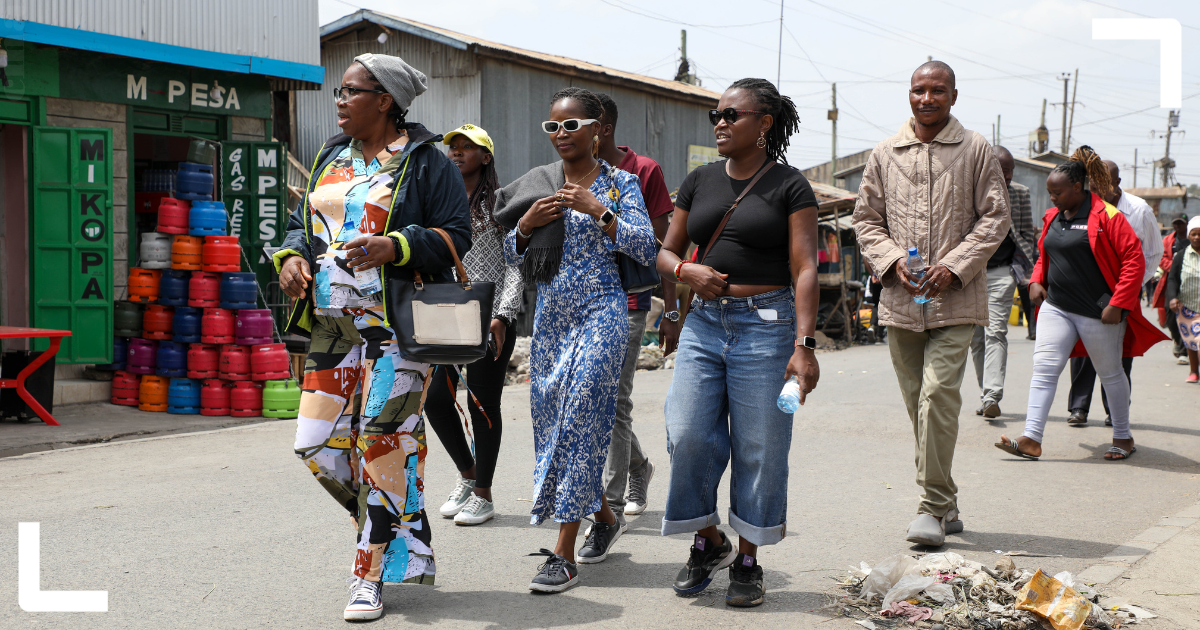
Header photo credit: Akiba Mashinani Trust. The ACRC Lagos team on their community exchange visit to Mukuru, Nairobi.
Note: This article presents the views of the author featured and does not necessarily represent the views of the African Cities Research Consortium as a whole.
The African Cities blog is licensed under Creative Commons Attribution-NonCommercial-NoDerivatives 4.0 International (CC BY-NC-ND 4.0), which means you are welcome to repost this content as long as you provide full credit and a link to this original post.
