
By Vivian Halerah Kangole, Nambi Inviolah, Nalubulwa Sumaiya and Nakigudde Saidat
Ggaba Market, located on the shores of Lake Victoria in Makindye Division, Kampala, is one of the city’s most lucrative markets for fish, fresh produce and basic essentials. For years, the market has battled with seasonal flooding, most significantly in 2021. Several factors – such as the rise in Lake Victoria water levels, underground springs, runoff water due to heavy rains and blocked drainage channels – were linked to flooding.
The blocked drainage creates small lagoons of water within the market, causing vendors to shift to alternative spaces. A young female vendor who had a well-established silver-fish (mukene) stall in the middle of the market was forced to move. She said, “The flood destroyed my stall, and I now have no permanent stall to work from. I must wake up early and find space on the ground to lay my foodstuffs and start working.”
What is soil filling?
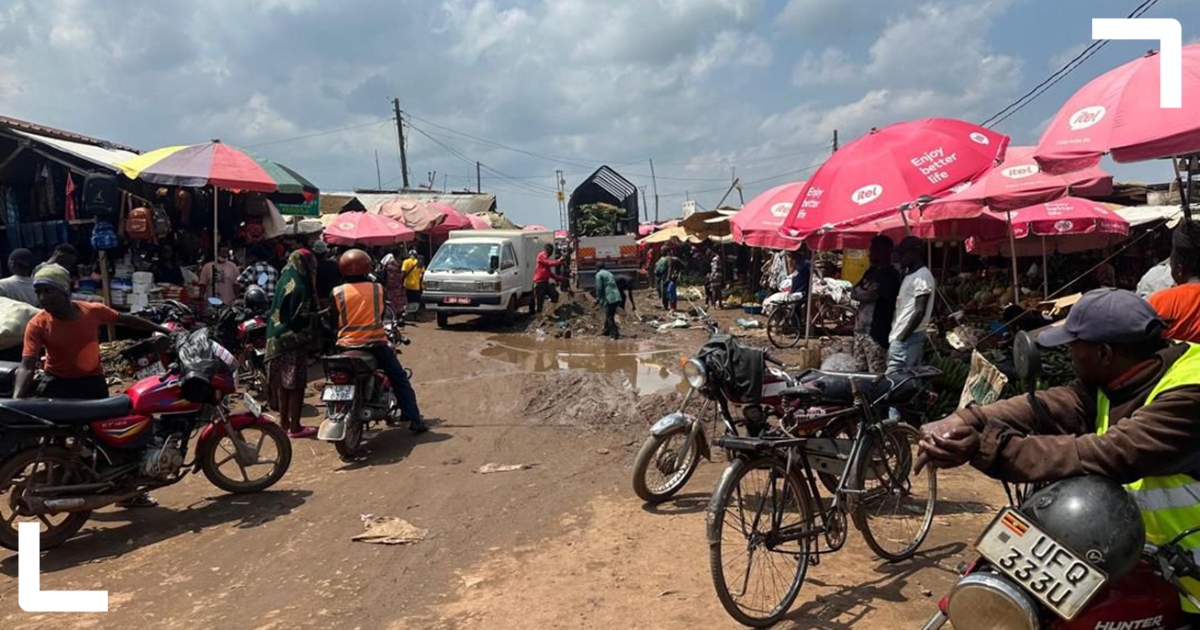
Walking around the market, piles of small and big murram soils – a mixture of gravel, sand and clay – are evident. These are a temporary solution, commonly known as “soil filling”, to address the mini-flooding across the market. Vendors who operate along the market pathways mobilise each other to purchase murram soil, in order to cover the waterlogged surfaces to ease access to the market. As a result, vendors believe raising the ground surface level will prevent flooding.
But is soil filling a solution to flooding or just a temporary bandage, potentially leading to a worse situation?
How reliable and effective is soil filling?
In the context of Ggaba Market, soil filling has offered temporary relief from stagnant water. It has created a clean, levelled ground to work on and made navigation easier for customers and vendors.
Another vendor of fresh produce says, “When it floods, roads become slippery and the market becomes inaccessible, and we end up not working because sometimes the water rises up to the ankle level … No customer is ready to risk walking on a slippery surface, most customers opt for alternative markets, like Kibuye.”
Vendors’ beliefs around soil filling seem to be valid in terms of providing a safe work environment and customer motivation. On the other hand, vendors at the centre of the market face a dilemma, since soil filling was not affordable to them, and stalls on lower ground suffered more from the consequences of flooding than those on higher ground.
Is there cause to worry?
Ggaba Market lies on a slope, making it more prone to erosion. Merely placing soil on the ground surface without compaction means continuously refilling. Compaction work is needed to ensure that roads and pathways are firm and stable, but this practice has led to narrowed access roads, making movement in and around the market difficult.
Manda Road (which translates to “Charcoal Road”) used to provide direct access to the charcoal section of the market. But it has now narrowed to such an extent that heavy vehicles are unable to transport timber and charcoal directly to the stalls. Instead, vendors incur extra costs to pay labourers to offload and carry goods to the stalls. The narrowing of paths has also created congestion in the market and blocked emergency access routes for ambulances and fire engines, which may lead to future disasters and safety hazards.
We also discovered that vendors at the fish fillet section had collaboratively constructed a wood and timber platform over the drainage channel and the flooded areas, creating a deck designed to keep their workspace above the knee-level rising water. Debris, waste and mud eventually became trapped underneath this platform, reducing the space needed for water to flow. This adaptation – an effort to make the market safe for normal operations – would in effect seal off the market’s main drainage channel.
Survival or progress?
The issue of flooding in Ggaba Market is not merely about water, mud or makeshift piles of murram soil. It reflects a larger, structural failure that has pushed vendors to engineer temporary solutions in a space that should be safe and functional. Soil filling, wooden platforms and narrow roads are not a sign of a market trying to progress but symptoms of a market trying to survive without adequate support.
It is becoming clear that flooding in Ggaba is not only an environmental challenge but also a governance concern. Vendors have taken the initiative to fix challenges at their own expense, despite existing leadership. These innovations, however admirable, should not be the default solution to a widespread market crisis. The authorities who are mandated to manage and maintain market infrastructure need to do their part. Otherwise, Ggaba Market and its vendors will remain stuck in a cycle of recurring vulnerabilities and temporary fixes for survival.
Header photo credit: Ggaba action research team. Market vendors undertaking a soil filling activity to rid stagnant water.
Note: This article presents the views of the authors featured and does not necessarily represent the views of the African Cities Research Consortium as a whole.
The African Cities blog is licensed under Creative Commons Attribution-NonCommercial-NoDerivatives 4.0 International (CC BY-NC-ND 4.0), which means you are welcome to repost this content as long as you provide full credit and a link to this original post.
