By Deji Akinpelu
On a plot of land in Ajegunle-Ikorodu, Lagos that could easily have become another illegal dumping site, something different is taking shape. Plastic bottles that once ended up in nearby drainages can now be traded for cash, while food waste is being turned into compost and used to support an urban farm.
The transformation began with an important question: what actually happens to the waste generated by households and vendors in an informal community where formal collection services do not consistently reach?
Ajegunle-Ikorodu’s waste challenge was also an evidence gap
Recent statements by the Lagos State officials indicate that the volume of waste generated in Lagos may now be closer to 17,000 tonnes of waste daily, up from the 13,000 tonnes usually cited by the State. With much of this waste ending up in landfills, the State Government is exploring ways to promote source separation and recover value from waste through waste-to-wealth and waste-to-energy initiatives. However, far less is known about the volume of waste generated within communities, particularly in informal settlements where the potential for recovery and reuse may be significant.
The baseline study focuses on Ajegunle-Ikorodu, a low-income informal settlement in Kosofe, Lagos, and sets out to close part of that gap by conducting rigorous household surveys through citizen mobilisation, identifying existing waste practices and service providers and quantifying waste generated within the community from households and food vendors.
The study was undertaken by Rethinking Cities in partnership with the Centre for Housing and Sustainable Development (CHSD), University of Lagos, with support from the African Cities Research Consortium (ACRC).
The baseline results showed both service gaps and a local waste economy
The results showed the scale of the challenge. 67% of households reported no access to the formal collection trucks. This gap sits within a formal collection system coordinated by Lagos State Waste Management Authority (LAWMA) and delivered through Private Sector Partnership (PSP) operators. Many residents therefore rely on burning, open dumping and scavengers (abokis). Meanwhile, 59% of respondents reported experiencing flooding monthly or more during the rainy season, highlighting issues relevant to the ongoing climate resilience project in the community.
During Focus Group Discussions, participants linked the flooding to waste disposal practices, including dumping waste in canals and drainages and using it to fill potholes. Yet the data also revealed an existing waste economy: 70% of households already sold recyclables to informal collectors, and 65% earned some income from doing so, with some reporting monthly earnings of up to N30,000.
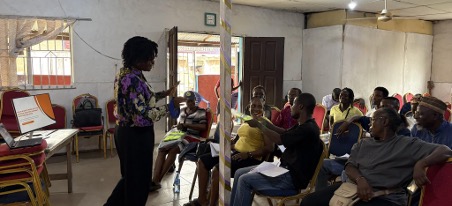
The baseline was designed to understand these realities with the community members. Community Waste Investigators, many of them members of the local SDI Federation, were trained to participate directly in data collection. They led a structured survey of 303 households across the neighbouring Ajegunle, Irawo and Thomas Community Development Associations (CDAs). Five focus group discussions brought together landlords, tenants, women, youth and informal waste pickers, while key informant interviews with CDA leaders added further context.
The findings were subsequently shared with community members and stakeholders at a community engagement that brought together the ACRC Lagos team, government representatives, civil society organisations and residents. The study and its findings also received coverage from The Guardian, THISDAY, Development Reporting and The CHSD.
Community research turned findings into a working integrated circular economy hub
The result was more than a dataset. The study found an estimated 85% willingness to participate in a better waste management system, creating an opportunity to move from evidence to action. A five-day physical waste audit then sorted 619kg of waste from 161 samples across 16 locations within the community.
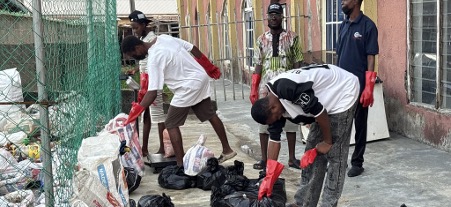
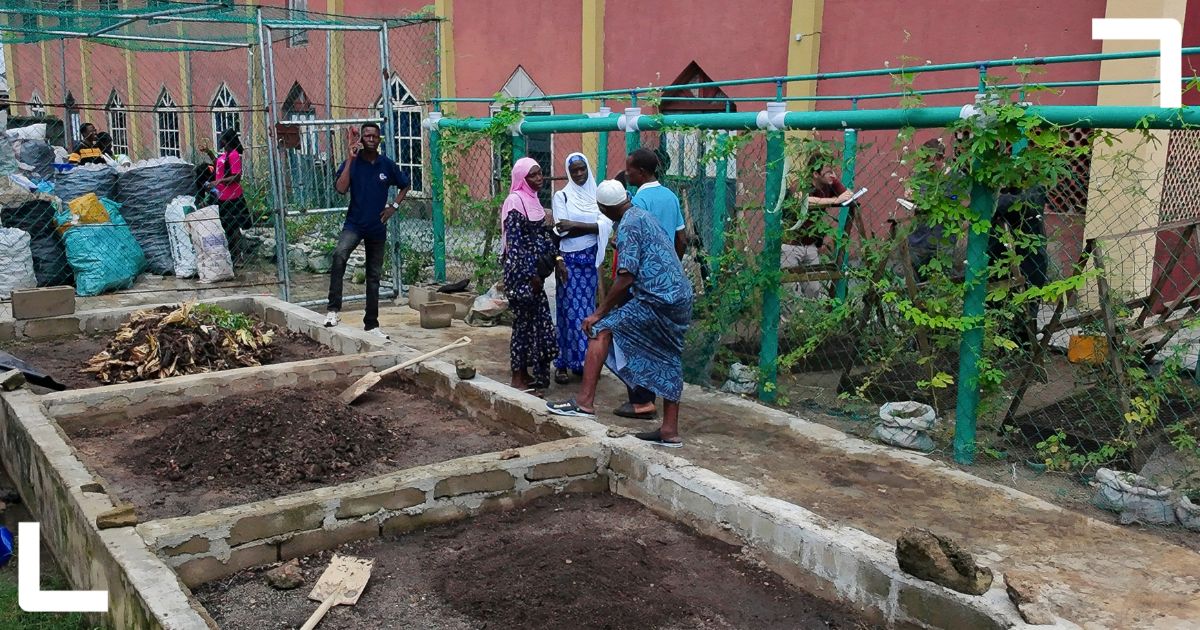
The community waste quantification became the basis for an Integrated Circular Economy Hub or Green Hub on a site that had been on its way to becoming another illegal dumping ground. The community leader (Baale) decided to donate the used land space to prototype the project.
The space became open to construct a hub for the Community Waste Investigators to operate, bringing together recycling, composting and urban farming in one community-managed space. Its recycling stream receives materials including plastic bottles, nylons, paper and metals, creating a route for recoverable materials to re-enter the market.
Food waste, specifically fruit and vegetable peels are channelled into composting, while the urban farm reuses recovered plastic for farm structures and irrigation. Crops are also grown in sacks using compost to support the growing cycle. Together, these activities demonstrate how materials that would otherwise be discarded can be recovered and redirected into productive uses.
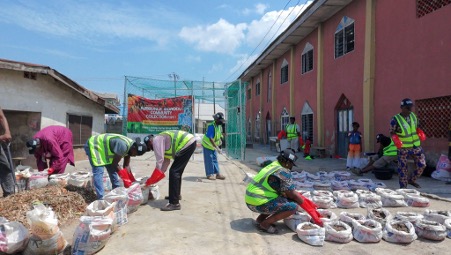
More importantly, the hub makes the waste system visible.
Residents can see what is separated, where recyclable materials go, how organic waste is processed and how recovered materials can support other community activities. This creates a practical space for learning, testing ideas and building local capacity, while also generating evidence on what is feasible in a dense, underserved settlement. The aim is not to treat the hub as a standalone facility, but as part of a wider system of community action, market linkages and institutional engagement.
The hub is managed by members of the original Community Waste Investigators, who have since become Community Waste Champions. The Association of Scrap and Waste Pickers of Lagos (ASWOL) provides technical guidance on plastics pricing and marketing, while community leaders and government stakeholders have demonstrated buy-in. This early involvement has helped ground the model in local ownership and create connections between community practice and formal institutions.
New evidence is reshaping where the project goes next
The experience of the hub is already influencing the project’s next phase. Phase One analysis demonstrated that 80% of collected food waste originated from just 20% of collection points, primarily commercial food vendors who produce cleaner waste streams. As a result, Phase Two will focus collection resources on vendor clusters, while redirecting household efforts towards education on home composting for small-scale farming.
The team will also strengthen the integration of informal waste pickers, many of whom are from Northern Nigeria with farming backgrounds, into the hub’s recovery system, linking their existing role in collecting recyclables and their farming experience with more organised collection and market access.
Alongside this, the team is considering faster composting methods, including black soldier fly larvae composting, which could reduce processing time and create a potential marketable feed product. Then, a farm-to-table model through the urban farm.
In parallel, proposed standard guidelines for developing and operating Green Hubs will draw on technical oversight from the Lagos State Environmental Protection Agency in collaboration with other stakeholders, while the team explores how hub data could connect to carbon and plastic credit opportunities.
From one community to a wider model for Lagos
The model has begun gaining momentum beyond the community. Representatives from various government ministries, departments and agencies have visited the site, including officials from the Office of Climate Change and Circular Economy, the Lagos State Ministry of the Environment and Water Resources, the Lagos State Environmental Protection Agency, the Lagos State Resilience Office, as well other institutions like the Resilient Cities Network, C40 Cities, Lagos Urban Development Initiative, amongst others.
A stakeholders engagement hosted by Heinrich Böll Stiftung brought civil society and government stakeholders together, while the Lagos State Ministry of the Environment and Water Resources has committed financial support towards efforts to replicate the model in Ojokoro and Amuwo Odofin while also collaborating with the team to host a programme for World Cleanup Day.
The initiative sits within a broader shift in Lagos towards waste sorting at source, organic waste processing, methane reduction and the circular economy. Its contribution is to add community-generated model and practical experience to that vision.
What began as a study of how waste moves through Ajegunle-Ikorodu is becoming a model for exploring how community residents, informal actors, researchers and government can work together to recover materials, improve local systems and develop responses that can be adapted elsewhere.
Photo credits: Deji Akinpelu
Note: This article presents the views of the author featured and does not necessarily represent the views of the African Cities Research Consortium as a whole.
The African Cities blog is licensed under Creative Commons Attribution-NonCommercial-NoDerivatives 4.0 International (CC BY-NC-ND 4.0), which means you are welcome to repost this content as long as you provide full credit and a link to this original post.
