By Mojeed Alabi, ACRC Lagos uptake lead
A capacity building workshop for journalists and researchers was recently held in Lagos by DevReporting – in partnership with the Pro-Poor Development Media Network (PDM Network) and with support from ACRC.
The aim was to strengthen the link between academic research and development journalism, by supporting journalists to produce evidence-informed and advocacy-driven stories on key urban challenges in Lagos.
Following the workshop, DevReporting assigned eight selected journalists to receive one-on-one editorial guidance from two mentors. Each mentor worked with four journalists to help strengthen their evidence gathering and maximise story quality and impact.
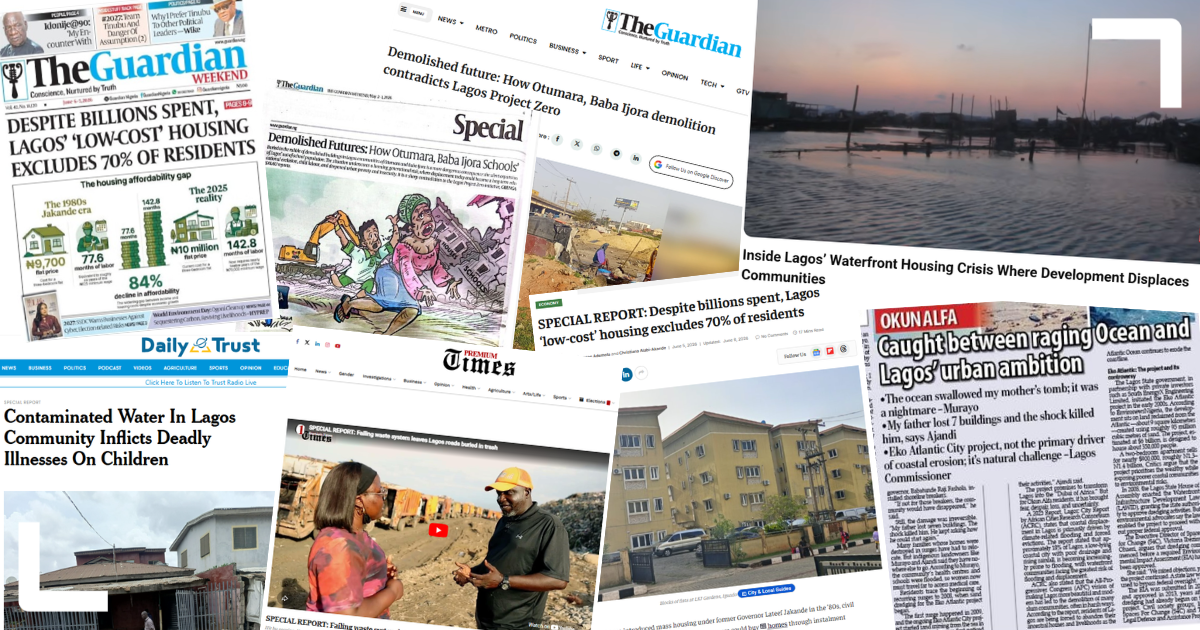
So far, the journalists mentored as part of this project have had six stories published across print, broadcast and online platforms, with two remaining stories underway. The published stories are summarised and linked below.
DevReporting | “Despite billions spent, Lagos’ ‘low-cost’ housing excludes 70% of residents”
Samson Ademola and Christiana Alabi-Akande’s report reveals how Lagos State’s public housing schemes have become unaffordable for the low-income earners they were designed to serve. Despite billions of naira invested in housing projects, high prices and stringent mortgage requirements exclude most informal workers and low-income households, widening housing inequality and leaving millions without access to affordable homes.
Premium Times | “Failing waste system leaves Lagos roads buried in trash”
Folashade Ogunrinde’s report explores how rising operational costs, inadequate waste infrastructure, weak regulatory enforcement and poor payment compliance have strained Lagos’s waste management system. The report shows how irregular waste collection has pushed residents to dump refuse on roadsides and drainage channels, worsening environmental and public health risks, while exposing the limitations of ongoing reforms in addressing the city’s growing waste crisis. This story also comes with a 15-minute documentary, exposing the failure of the waste management system in the city.
The Guardian | “Demolished future: How Otumara, Baba Ijora demolition contradicts Lagos Project Zero”
Gbenga Salau’s story exposes how the demolition of homes and schools in Otumara and Baba Ijora has disrupted the education of hundreds of children, forcing many out of school and into street trading, child labour and precarious living conditions. The report argues that the evictions undermine Lagos State’s Project Zero initiative to eliminate out-of-school children.
New Telegraph | “Okun Alfa: Caught between raging ocean and Lagos’ urban ambition”
Juliana Francis’s report explores how coastal erosion, ocean surges and displacement continue to threaten residents of Okun Alfa. It highlights how the Eko Atlantic project and other activities worsened environmental vulnerabilities, destroying homes, livelihoods and public infrastructure, while exposing tensions between elite urban development and the rights of coastal communities to housing and sustainable livelihoods.
Daily Trust | “Contaminated water in Lagos community inflicts deadly illnesses on children”
Eric Dumo’s report reveals how residents of Ago Egun, a Lagos waterfront settlement, face a deadly public health crisis from contaminated water and absent sanitation infrastructure. Children suffer frequent diarrhoea, typhoid and dysentery, with several dying in disease outbreaks. Despite over ₦66.9 billion spent on water infrastructure since 2019, Lagos State Water Corporation meets only 35% of daily demand.
Punch | “Inside Lagos’ waterfront housing crisis where development displaces communities”
This documentary, produced by Melony Ishola, examines the lingering human cost of Lagos’s waterfront demolitions. It follows displaced Makoko residents still living in boats and makeshift shelters months after their displacement, while exploring the city’s broader housing crisis and the uncertain fate of relocation promises made to affected communities.
These commissioned reports have gained some promising attention to date, including responses from the Ministry of Housing’s head of information, the Lagos State Universal Basic Education Board’s management and the Lagos State Commissioner for the Environment and Water Resources, along with increased collaboration across media titles and wider public commentary.
Five key lessons emerged from the workshop and subsequent mentoring scheme:
1. Training enhances clarity and alignment.
2. Capacity strengthening remains necessary, even for experienced journalists.
3. Collaboration facilitates access and improves story development.
4. Community reporters require additional support to maximise impact.
5. Multimedia and documentary content amplifies story engagement.
Following the publication of the commissioned stories, we will continue to monitor and track government responses to the published reports. The success of the initiative has also generated strong interest from Nigeria’s media industry, with leading news organisations, including The Guardian, Premium Times and News Central Television, expressing interest in a collaborative platform to enable journalists to jointly report on urban development challenges. This growing momentum presents an opportunity to build a network of newsrooms committed to reporting on urban issues.
Header image credit: Composite of news reports
Note: This article presents the views of the authors featured and does not necessarily represent the views of the African Cities Research Consortium as a whole.
The African Cities blog is licensed under Creative Commons Attribution-NonCommercial-NoDerivatives 4.0 International (CC BY-NC-ND 4.0), which means you are welcome to repost this content as long as you provide full credit and a link to this original post.
