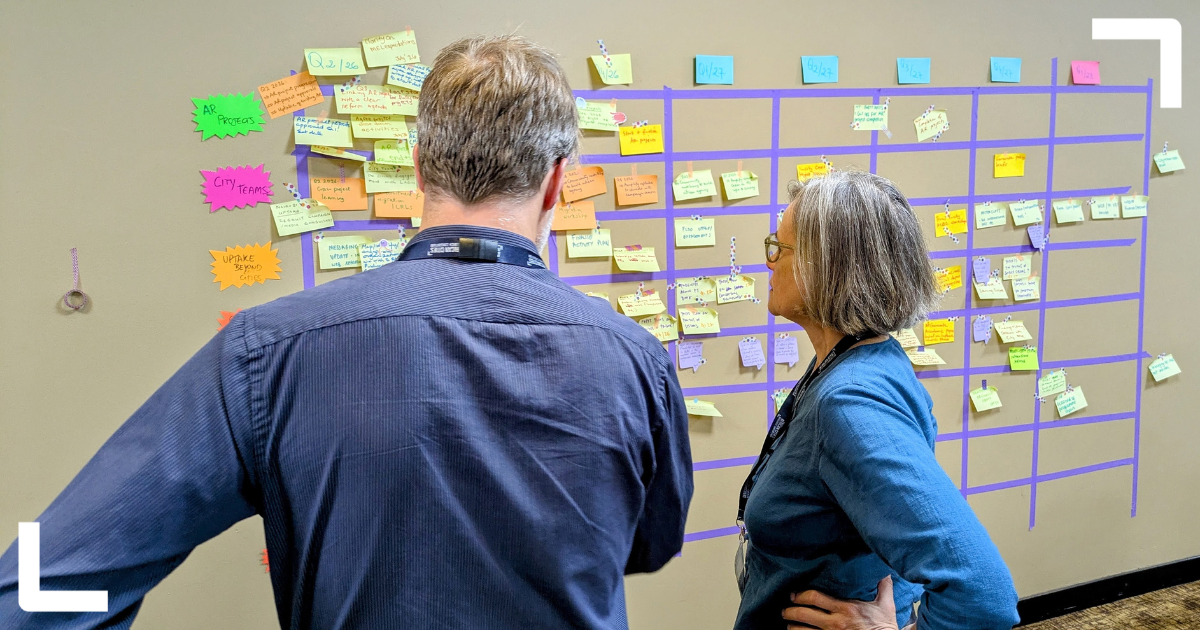
Hear from ACRC’s CEO, Tom Goodfellow, as he tells us about how he got into urban development, what he finds most interesting about the ACRC approach, what African cities can do to drive progress, and more.
Watch the video profile and read the full conversation below…
Tell me about your role in ACRC and what you’re working on at the moment?
So I’m Tom Goodfellow and I’m coming into the role of CEO of the African Cities Research Consortium, which means I’ll be working alongside our fabulous senior management team in the consortium – located in various parts of the world – to lead the consortium into the next phase of its work, as we get a load of action research projects to completion, deliver outputs and start thinking about learning between our many projects, which are taking place in seven cities across Africa.
Some of the things I’ve been doing recently particularly are around getting some of the last action research projects in our portfolio to the point where they’re finalised and ready to go, because some of them are only just starting. That includes for example new projects to secure land rights for communities in Kampala in Uganda – building on an earlier study we’re trying to really roll that out on the ground. We’ve got projects around school feeding in Nairobi, trying to ensure that children in informal schools across the city can have access to food. Also, there’s work going on in Lagos, for example, around much more equitable models of property taxation for low-income communities in the city. So those are some of the projects that we’re working to get off the ground.
And I’m also excited because we’ve got a new area of work emerging around rural–urban migration and other kinds of migration into cities, and through this we’re really trying to get a better understanding of mobility patterns in the context of the African cities we work in.
How did you get into urban development?
Well, that’s a very interesting question as it’s not something I necessarily anticipated, having not really studied cities or even geography earlier in my kind of life and career! But I became interested partly through a friend’s mum, who was an academic working on cities in South Africa after apartheid. And I got interested in how cities, particularly divided cities and conflict-affected cities, overcome those kinds of things. And through that work, I ended up doing a PhD, where I was looking at post-conflict cities and rapidly growing cities in post-conflict environments, particularly in Uganda and Rwanda, which is where I did my PhD research.
So I became really interested in cities in Africa in the context of rapid growth, how you manage issues around land and infrastructure and housing in that context. And then from there, I ended up doing more comparative work with colleagues in different parts of Africa, and that leads me to where I am. So it was kind of an accident when I ended up doing a little bit of a favour for a friend’s mum, helping her out with some stuff she was writing for a publication, and just got hooked.
What’s interesting about the ACRC approach?
There are so many interesting things. It’s quite challenging to choose just one. I won’t say anything here about a particular project or a particular theme of the work we do, but one thing that I’m finding really interesting is how projects spin out from something that can be quite small on the ground. It can be a particular site where there’s waste recycling, or it can be one particular part of a neighbourhood where some drains are being put in, and how this kind of small project can spin out into this large network of committed organisations and individuals to get this thing to work, to get this thing to really bring a change.
It grows from something small into something much bigger in terms of all the people who have to be involved and you can see the energy growing, whether it’s government agencies getting involved, communities themselves, organisations they work with, and you start to see those systemic interactions: how waste and climate resilience and water and sanitation all connect to each other through this one small project initially. So I think that’s what I’m really learning: how we see change spinning out from particular sites or particular issues into wider, more systemic forms of change.
What ACRC paper, blog or podcast do you most recommend?
Well, there are many that I recommend and we’ve got this very vibrant blog series, so I do hope that people keep an eye on that because blogs come through very regularly that really showcase the action research projects on the ground. That’s the best way to see what’s happening. We also have many project reports in the pipeline, as most of our reports about the active action research are yet to come, although we have many really interesting studies already online as well.
I’m quite keen on podcasts, not least because I also get involved in making them sometimes, and one that was really interesting to me was when I had a conversation with two of our city managers, Jack Makau in Nairobi and Temilade Sesan in Lagos. They were talking about how they learned from each other and how their cities learned from each other. That’s come out and been put out recently through the African Cities podcast. I do recommend that for people who are interested in that kind of transnational, translocal learning about how urban change happens.
How can cities drive progress?
Very good question – I’m mostly obviously interested in what all of our partners based in the cities we work in have to say about that in their own cities. But thinking across the whole set and the wider issues, I think we see cities learning a lot from each other, in two ways, very obviously. On the one hand, you see city governments and national governments learning about how to market their cities for investment, to sort of position them within regional and global orders as kind of sites of modernity and investment. And there’s a lot of learning that happens there. And secondly there’s a lot of learning that happens between communities about how to try and assert their rights.
What I’d like to see more of, I think, is something in between, which is really about municipalities and city governments learning from each other – not just about how to market and get investment, but about how to really realise the value of their populations, how to work effectively with communities in ways that actually helps to enhance the city without undermining community rights. Because we do see rights being undermined in some of our cities. This is about learning not just between the big cities but also the smaller cities and the secondary cities where most of the growth is happening, to really see more of those cities leading the way sharing examples, as well as learning from bigger ones, so that we get a sense that smaller cities are also celebrated and we can see the innovation happening there. I mean, I’m based in the city of Sheffield, which in the UK is one of those smaller cities, so I often think about how we could be engaging with and learning with smaller places as well.
What do you enjoy doing in your spare time?
Well, it’s interesting because you asked about how I got into urban development, and I didn’t mention this but the friend whose mum got me interested in African cities – she herself was South African – I was in a band with her son and used to play music a lot. Since having children and having a different kind of life for a while, I’ve kind of lost the habit, but I’m getting a bit more into it again now – not least because my children are really interested in music and play quite a few musical instruments between them. So I’ve been getting back into that and making use of the fact that we have more musical instruments around the house. So that’s been nice.
Sign up to our newsletter for regular updates on ACRC action research projects, new publications and expert insights into urban development in African cities.
Header photo credit: Chris Jordan
Note: This article presents the views of the author featured and does not necessarily represent the views of the African Cities Research Consortium as a whole.
The African Cities blog is licensed under Creative Commons Attribution-NonCommercial-NoDerivatives 4.0 International (CC BY-NC-ND 4.0), which means you are welcome to repost this content as long as you provide full credit and a link to this original post.
