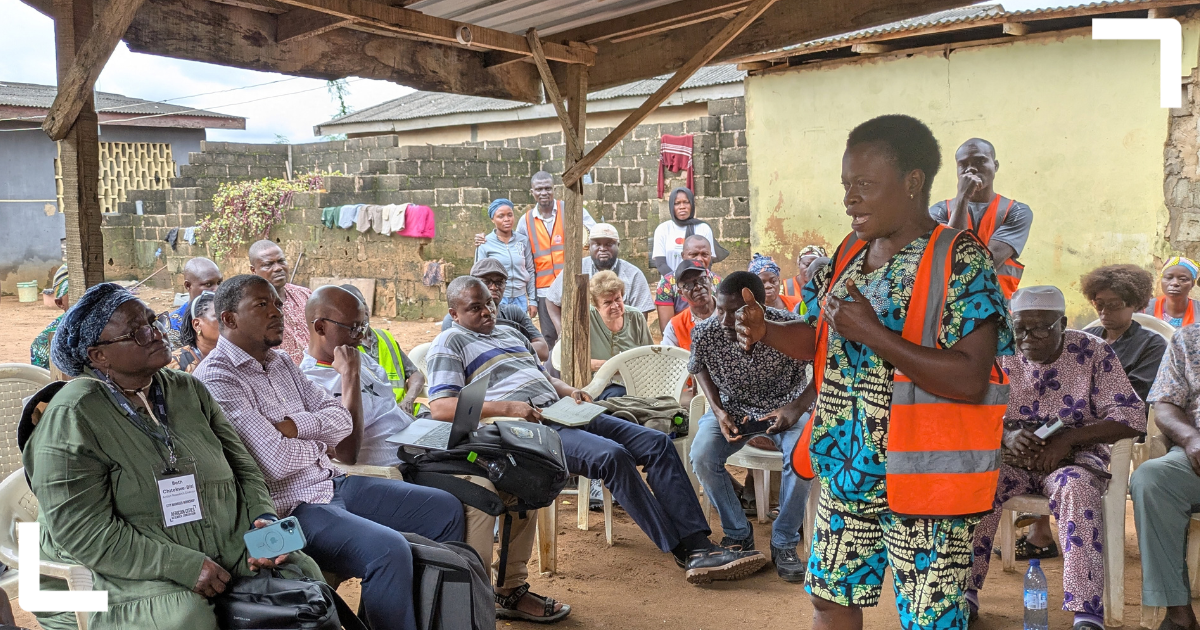
Communities are experts in their own lives. They understand the challenges, opportunities and political realities they face every day in ways that outside researchers might struggle to uncover. So how can communities work with academics and harness that knowledge to drive meaningful change?
In this episode, Chris Jordan is joined by Beth Chitekwe-Biti and Diana Mitlin for a conversation about the role of community knowledge within ACRC and beyond – including what it is, how it works and how it fits into ACRC’s research processes and aims around urban reform.
Drawing on examples from Harare, Nairobi and Manchester, they talk about how community-led data collection can strengthen agency, issues of data ownership, the impact of digitalisation, and the “unlearning” often required for academics and communities to create strong knowledge partnerships.
Beth Chitekwe-Biti is community knowledge research director for the African Cities Research Consortium and executive director of Slum Dwellers International (SDI).
Diana Mitlin is former CEO of the African Cities Research Consortium.
Chris Jordan is communications and impact manager for the Global Development Institute at The University of Manchester, and ACRC’s communications manager.
Transcript
The full podcast transcript is available below.
Read now
Chris Jordan Hello and welcome to the African Cities Research Consortium Podcast. My name is Chris Jordan, I’m the communications manager with ACRC and we’re here today to have a conversation around community knowledge – what it is, how it works, and how it fits into ACRC, its research processes and its aims around urban reform. I’m joined today by Beth Chitekwe-Biti. Beth is managing director of SDI, she helped found the Zimbabwe Homeless People’s Federation, she completed her PhD with us here at Manchester and is currently the research director for community knowledge with ACRC. Also joined by Professor Diana Mitlin. Diana is former CEO of the African Cities Research Consortium and has a really long history of working with SDI and their community-based federations. So, Beth and Diana, welcome.
Beth Chitekwe-Biti Thank you.
Diana Mitlin Thank you.
Chris Jordan So Beth, if I could start with you. What does the term “community knowledge” mean to you and why is it important?
Beth Chitekwe-Biti So for me, community knowledge starts on the premise that the communities, whether they are informal settlement dwellers or slum dwellers or market queens, they are the experts of their own lives. And that expertise that is shared over time because of their lived experience is community knowledge. They understand the nuances of dealing with outsiders, be they politicians or other stakeholders, and often these nuances and, I suppose, skills or strategies are often not very clear or evident to people that are outside of that community. So it’s that knowledge that intrinsically exists because of people are and where they are.
Chris Jordan And it’s quite central to SDI’s approach, right? What actually makes it powerful, as far as you’ve seen?
Beth Chitekwe-Biti What makes it powerful really stems from, first and foremost, the deprivations that the communities that SDI traditionally works with, so slum dwellers, the deprivation they experience and understanding that farming out the solutions to address those challenges often results in ill-fitting strategies. So if you look at our world, it’s lit with a number of white elephants because solutions have been developed from outside. But it also is about agency and people taking responsibility for their own lives, and partnering with outsiders based off what it is that they themselves can’t do, but also determining what outsiders and how outsiders need to interact with them. So that component around agency and having the voice to be able to say “this is what we need and this is how we need it”, rather than just receiving or accepting solutions that are coming from outside.
Chris Jordan Thanks. And Diana, you’ve worked with SDI for a long time now. How have you seen community knowledge work within these kind of federations and communities and the knowledge processes that you’ve been involved with as a Northern researcher?
Diana Mitlin Thank you. Thank you, Chris. And thanks for Beth for starting us off on this important discussion. I think from the beginning, as we thought about how to bring the African Cities Research Consortium together to make the most effective contribution to inclusive urban programming, we were really clear that we needed to find ways to incorporate communities and incorporate them really effectively as key knowledge partners, if I might say that. We, as you know, Chris, we’re both doing action research and learning from the action research process to understand urban programming, and we’re really trying to understand the key urban constraints and the urban opportunities in the context in which people find themselves and what that means for urban scholarship more generally. We have – I say “we” very deliberately, as you know in GDI, I’m not the only one who works with SDI – we have long acknowledged the important contribution that residents, informal workers have to understanding those constraints and opportunities and understanding ways to address them. So we were clear they had to be included from the beginning. I think at the same time, and Beth and I have discussed this frequently, we also recognise that as leaders in residents’ associations, worker groups, as they engage with other specialists, academics and professionals and better understand the challenges through their eyes, they develop new analytical understandings. I mean, both Beth and I have worked for a long time with federation leaders, and there’s a process, it’s like, “Oh, now I get what you’re asking about. Let me tell you about what we’re doing here.” So that kind of process of learning is two-way. Local community leaders learn to be more analytical about what are the political constraints they face, what are the multiple ways in which different people in their neighbourhoods are trying to manage local leaders, who may be very paternalistic, sometimes positive, sometimes negative. What are the ways they’re managing that and how can that knowledge be captured? So we don’t see it in a way as simply developing better means of communication with community activists. We really do see it as a co-learning process, whereby we can better understand, we can see the world through their eyes, and they see the world through our eyes and see it a bit differently, and we learn together about what the problems and opportunities are, the ways in which those can be addressed, but also the ways in which that learning is represented.
Chris Jordan And I wonder if you could just outline, more from an academic perspective, how is community knowledge understood? Does this differ between different social science disciplines? And, overall, how seriously is it taken?
Diana Mitlin That’s a really good question. I think this kind of real, you might say, passion, vocation, but also very scholarly approach to community knowledge is longstanding. So there’s always been a group of academics who’ve recognised the importance of understanding what it means to live in informal settlements, what it means to work informally, and who’ve really wanted to work in a collaborative fashion. So there’s been a kind of minority interest, you might say, in this work, and a deep appreciation of really people’s knowledge, wherever they’re located. There has in recent years become a broader understanding of its significance through, for example, work on fine-tuning approaches to participation, participatory research, participatory action research. So this has been for a long time a specialism, but a specialism which has been growing and has a recognised significance. Some of that, as indeed we have done, has been linked into decolonisation debates. There is relatively little appreciation, I think, though, about what it means to do that at a scale that goes beyond the project. So for us, what’s been really important in working with SDI, Slum Dwellers International, is the ability to work with groups that have been networked and federated and who’ve been doing that work now for decades. So we’re not going back to the beginning and we’re not constrained at the local. So we’re working with people who’ve had a level of exposure, who can rapidly come up to speed with what we’re trying to do, we can understand what they’re trying to do, but also because these federations and networks exist at the city and the national scales, that learning is not, for example, confined to “what are the problems with this political leader?” Rather, it’s linked into “what are the problems at the local level with leadership?”, but also “what are the ways in which the city leaders, political leaders, city officials understand the challenges we face, what are the ways in which that’s been captured at the national level in electoral choices?” So our opportunity here is really to try and both learn from community knowledge for ACRC, but also try and help the discipline, the multiple disciplines to take it forward in a wide variety of ways.
Beth Chitekwe-Biti I would also say that for SDI, I think the experience or the interest around academics, like studying SDI over the years, they’ve also sharpened, from the perspective of the leadership of the network and communities, what it is that they see as beneficial or as a two-way process and what they see as extractive, and being able to actually be quite confident in saying “you are not taking our information out”, and then that’s the end of it. So what is it, if you are coming to us with a research project, how do we co-design what it is we want to learn? How do they… there is a term that our federation leaders use – how do you unlearn what you have learned as an academic or as a professional, in order for you to really understand what it is the value of our existing knowledge, but also how you can then ask us the right questions that create that opportunity to then build our capabilities and capacities to actually analyse our own situation. So there is that progression and also that growth that has happened over the years.
Chris Jordan Beth and Diana, I know you’ve been involved in lots of different projects, initiatives, and you’ve seen where this has been powerful and where it’s made a difference. Could you just outline, what’s your favourite example or a few of your favourites?
Beth Chitekwe-Biti Favourite examples. Currently in Zimbabwe, the Federation had always organised in markets, they’ve organised in informal settlements. But the politics around access to markets is quite high in the context of an economy that is highly informal. And there was a lot of ambivalence around how do we enter into this space, because these are things that like our toolkit of how we have done things, will it work in this? And a combination of the action research process around ACRC, so the academic component, and the community coming in with the tools that they’ve used over the years around savings, has created such a powerful coalition of approaches, to an extent that this ambivalence and, I suppose, sense that they would find it very difficult to enter into this space actually did not happen. And I think that comes from that very careful assessment of how do we manage politics but then the academic angle coming in and then creating a level of, I would say, acceptance by the host community – that for me has struck me quite significantly.
Chris Jordan Thanks. And Diana, what are your favourites?
Diana Mitlin It’s truly hard to say because I think each time you see a community engaging with this and they realise something they didn’t realise before, you think that’s the one I really love. So let me flag three very briefly. I think the fascinating thing to me out of the example from the market in Harare is that having observed what happened, the traders association themselves decided to develop a database of the different traders around the market because they could see “okay, there’s something in this. We need to be able to own our own data. We need to develop our data and we need to own our data”. So that to me is definitely an exciting moment. I think a second exciting moment goes beyond Africa, is when we replicated some of these data collection processes in Manchester, and the community in the housing association tower block adjacent to the university in Hopton Court did the survey of residents, they were super nervous, they were very upset when people closed doors in their faces, but then when they produced the results and they shared those results with academics and with the housing association, with Manchester City Council, they also suddenly discovered the power of data. I think most recently, one of the examples of the work that African Cities Research Consortium has been partnering with has been in Nairobi, when 17 individuals working with waste, so people who scavenge waste, people from dump sites, people who collect waste from houses, people who aggregate those frontline collection services, came together and documented those processes, and then when they were sharing with us what happened when they shared their data with Nairobi City County government, who sadly for them suddenly realised that their approach to supporting informal waste collection in the informal settlements of Nairobi was simply partial, that the City Council officials did not have a good understanding of the processes that were involved. So they were missing really important groups. So you begin from all those examples, you realise that data collection by community residents, by workers is important for what it offers to them and their voice and their ability to represent their needs and interests, in addition to supporting learning more generally and engaging with researchers.
Chris Jordan Beth, I wonder if you could just outline how community knowledge processes have changed over time with SDI. Is it still the same approach as when SDI was originally set up or have things developed and moved on?
Beth Chitekwe-Biti I think the principles persist around agency and ownership. But of course with digitalisation some affiliates now collect. So initially we have now three processes of data collection. There’s one which we call profiles, which is really understanding the settlement. So the demographics, the available services, the opportunities and the challenges. Then there is where there’s a possibility of, say, an upgrade, there’s a more detailed potentially 100% coverage of a service, which we call enumerations, and then there’s mapping of settlements, because in a lot of cases, especially where people are living on illegal land, there is no documentation or mapping of the settlement itself. So there’s a key component of mapping. And ten years prior, all of this was likely manual. Now there are digital tools. There’s been pros and cons to this. Not every affiliate uses them or they use them together. The manual processes ensured that people actually visited every household. And so the information collected – and the Federation would tell you “we are not just collecting information, we’re also collecting people” – so there was also a component of mobilisation. And I know, for instance, the Namibians have completely refused to to digitalise that part because also digitalisation I suppose it can lock out people that are not digital natives. So young people, so you now have affiliates who use KoboCollect, for instance, and invariably the enumerators and the people involved have become younger. But of course the information perhaps is much more I guess rigorous and easy to clean. So there is the process in terms of the tools but I think one thing that has been consistent is the component around having an ultimate responsibility to feeding back, so there is an innate understanding that whatever information is collected belongs to that particular community, so that community has to understand, they have to check, they have to own that information and then hopefully use it either as a tool for development or advocacy. So those components, so while there might be changes, we are, for instance in Sierra Leone currently, we’re working with what it is Humanitarian OpenStreetMap and they have developed mapping software that is quite advanced to understand flood risk in one of the settlements. So the new tools are quite helpful but you still really need to go to the street again to have those conversations.
Chris Jordan Diana, what’s your perspective been? How has the technology changed things, particularly when communities are working with more academic researchers or with professional groups as interlocutors?
Diana Mitlin I think it’s definitely been tricky, and I think one of the motivations for SDI being interested in exploring the community knowledge space within African cities has been this consciousness that some of the engagement around SDI’s own data processes, some of the engagement of the older people, has been lost because of the advance of technology and because tablets and phones can pick up GIS, can be swift to record, all that data goes into the office. So I was talking a little bit to one of the old timers in Kampala, Waiswa, when we were talking about community knowledge, and he himself was saying “we’ve been discussing that”. So I think that is a challenge now. I think although the Namibians are resolute in saying we need to still collect data at the very local level, at the street level, in a way that community leaders can then aggregate locally and move up, that’s really quite unusual. And the other affiliates have really decided that, yes, we can collect data, it can get sent to the office, and there it gets aggregated. So I think finding ways in which that data is effectively shared, so the data is available as a tool for people who want to use it to progress their own political agenda – I use agenda loosely, but their need for water for sanitation and so on is important. I think that in each of the action research projects that we’re doing, we have really sought to motivate community leaders, informal settlement workers to think about what their knowledge needs are and to use the space of the African Cities Research Consortium to think about what knowledge do they need which will help them move forward. So at some level that includes the SDI tools that Beth has mentioned, so profiling of settlements, enumeration, household-level data, mapping to understand the spatial dimensions. But we’re also trying to explore new things. So, for example, the work in Mukuru, the WASH work, has really been drawing on community leaders to help set up governance systems to manage sanitation in shared plots, where most people are tenants and maybe one shack is the landowner or maybe the landowner is absent. So how can communities get data and use that data and build a governance system that links into the ward level to hold the landowners to account? That kind of task obviously has a professional component, but for us equally obviously it has a grassroots component. So we’re really very deliberately creating space to incorporate grassroots knowledge in that research and development process. I would say, to return to the way you placed your question, we said how easy do researchers find this? I think we can say that there’s a difference. So as you did in a previous podcast, talking about the experiences in Nairobi, Dr Mwangi spoke about how she had been so excited to work with school leaders and teachers and parents around new ways of knowledge. So we have those who are just so delighted to embrace this way of working and we have others who struggle a little more.
Beth Chitekwe-Biti Definitely.
Chris Jordan And I guess the availability of digital tools is a two-way thing as well, because presumably now more people have access to phones and social networks, but actually once the data is produced, there’s more avenues for people to share it within communities more broadly. Is that something you see happening Beth?
Beth Chitekwe-Biti So I think, especially if it’s data, the sharing of it, it’s still critical that it’s associated also with a conversation beyond just the sharing. But of course methods of organising, like WhatsApp is a great organising tool that’s used across the network, so there are digital tools that are being used or even just like calling a meeting to discuss data that has been collected, for instance. I would still think that in terms of data that has been collected for a specific use, so for instance sanitation, there is still that need for people coming together and sitting through and having a conversation and analysing it and really getting multiple perspectives of what this might mean and then ultimately if it is intended for use for advocacy to advance sanitation, for instance, then that conversation is collectively done.
Chris Jordan So Beth, if I can ask you just to put your African Cities Research Consortium hat on, so as research director for community knowledge, what are you hoping that the process, the project achieves around this space?
Beth Chitekwe-Biti So I think what was really great at the beginning was ACRC being very deliberate and challenging itself in terms of how knowledge has been generated and how cities have been studied and wanting to be different. I think in the initial stages, I was asking myself, we want to be different, but how do we, if you look at social sciences in terms of the methodology for data collection, what is it that you are going to do that is different? People have used focus group discussion, they’ve used surveys, they’ve used maybe researcher anthropology, for instance, immersing the researcher in that process. What is it that we are as ACRC doing that is different? This component around starting from the viewpoint that there is knowledge, and then the researchers coming up with the right questions, but also a willingness to unlearn what they might think are methods that would work and developing new methods. In our last community knowledge workshop in Nairobi, for instance, we found out from Accra to Harare, a large component of our knowledge has been passed on across the African continent through stories. And there was such a huge interest to incorporate this. So how – and by coincidence the profiling tool that I was talking about is really a story of a settlement – how did it start, why did it start, why was it named or what was it named? Because all those issues often are related to either the challenges, the community experience or the opportunities they saw. So I think hopefully, as part of this, we can ultimately create a compelling story around how community knowledge can push the boundary for community knowledge within academic research but also how communities on their own can engage with researchers in terms of what it is, so that the process is not just extractive but actually it is a dialogue and a conversation.
Chris Jordan Within ACRC we’ve had a mix of different cities, so some have really strong, well established SDI federations. Some it’s been a bit more nascent, and a few of them there’s been very little SDI presence at all. Has it been interesting to look across different cities to see the different dynamics emerge?
Beth Chitekwe-Biti My colleagues will kill me. Yeah, there is and in some ways there are both pros and cons, because SDI is very established. In some cities where SDI is very established, trying to then have a conversation around “okay, how can we actually do this differently?” or “what is it that we can add to what we already know?” can be met with resistance, because people are so set in how they do things. So we have a case in point with Nairobi, where we developed terms of reference for the community knowledge too. And quite politely, they did not use those because ultimately they wanted to test something different and through that process, the analysis and the knowledge that was created was quite rich. Whereas if we had standardised, as we have done across the other cities, we might not have been able to get that richness. But my sense is, irrespective of that, people who are often studied by academics, there are power imbalances, and what has been really great about the cities that have strong SDI affiliates is they have already embedded confidence about their worth and what they know and why their knowledge is important, but also are willing and able to demand more from academics in terms of how they engage with them. So there is that dynamic.
Chris Jordan And it’s really struck me on the few occasions where we’ve been able to bring all the city teams and community researchers together, it’s been really interesting to see community workers, community researchers work as a caucus and to share their experiences and to challenge researchers as a block.
Beth Chitekwe-Biti Yeah, no, they’re not shy at all.
Chris Jordan What’s your perspective then, Diana? I mean obviously having organised communities, pushing for change is one of the central areas of the theory of change. Have you seen that kind of evidence for that emerging through the process so far?
Diana Mitlin So I think we’ve definitely got strong communities pushing for change. I think the examples Beth has mentioned, the examples I’ve mentioned, we have a whole host of others that you can see and interested listeners can see on our website. I think that there’s still work to do, still work in progress. I think that we are always looking to capture effective dialogue between the community components, community participants, community researchers and academics. We’re developing a suite of tools that come out of different projects about how they can better engage with each other and find things out together. So I think that’s already something that is working really well. I think we have succeeded within the SDI family in making those groups more deliberate in realising that they should be a little bit clearer in dealing with researchers about “these are our objectives, this is what’s important to us, how can we find a way to talk about that?” I think that’s working well. I think together those things, the tools, the changed academics, the slightly more demanding SDI groups, and groups beyond SDI as well, I think you made the point that we’re not just working with SDI affiliates, we have a host of other community groups. Making them more demanding is creating the conditions under which there is unlearning going on, I think on all sides. So groups are trying to unlearn. I think we are resetting expectations about what grassroots experience, what grassroots knowledge can offer to academics and professionals, and at the same time, how willing some professionals and academics are to really find ways to co-constitute a new kind of knowledge. I hope that as we move forward, we’ll deepen and broaden this work. I think it really shows amazing potentials for ensuring that expertise addresses really fundamental issues of exclusion, of disadvantage, of poverty reduction. I think that is the point at which these groups come together. I think we can potentially really develop a set of approaches that demonstrate how expertise is relevant, is important and if it is so constituted it can really work effectively.
Chris Jordan So just to start to draw the conversation to a close, Beth, looking forward more broadly, what else do you think can be done to really raise the profile and understanding about the central importance of community knowledge in urban reform processes? Is this about a case by case, site fights, and trying to get to the city level, or is it working beyond or is it a bit of both? What’s going to move the dial?
Beth Chitekwe-Biti So if I reflect back across the ACRC journey, I think we definitely have made the arguments of the validity and centrality of community knowledge within research and in our understanding of the urban development challenges, be it power, be it exclusion, be it opportunities. What I hope we do is to communicate what we have learned and what we continue to learn in a way that allows for more uptake by other researchers, but also even professionals who are working and dealing with grassroots organisations. I think that’s the frontier. Because for urban development interventions to be relevant and really address deep-seated exclusion, but also in a way that benefits people, it’s absolutely important that this component of the learning is embedded in that process.
Chris Jordan Thank you very, very much for joining me today. Really interesting to talk and I can’t wait to see how all of this develops, which we will obviously keep you up to date with on the podcast, on the blog and our social media. So thank you very much.
Beth Chitekwe-Biti Thank you, Chris.
Diana Mitlin Thank you, Chris.
Outro You have been listening to the African Cities podcast. Remember to subscribe for more urban development insights and interviews from the African Cities Research Consortium.
Header photo credit: Chris Jordan.
Note: This article presents the views of the author featured and does not necessarily represent the views of the African Cities Research Consortium as a whole.
The African Cities blog is licensed under Creative Commons Attribution-NonCommercial-NoDerivatives 4.0 International (CC BY-NC-ND 4.0), which means you are welcome to repost this content as long as you provide full credit and a link to this original post.
