
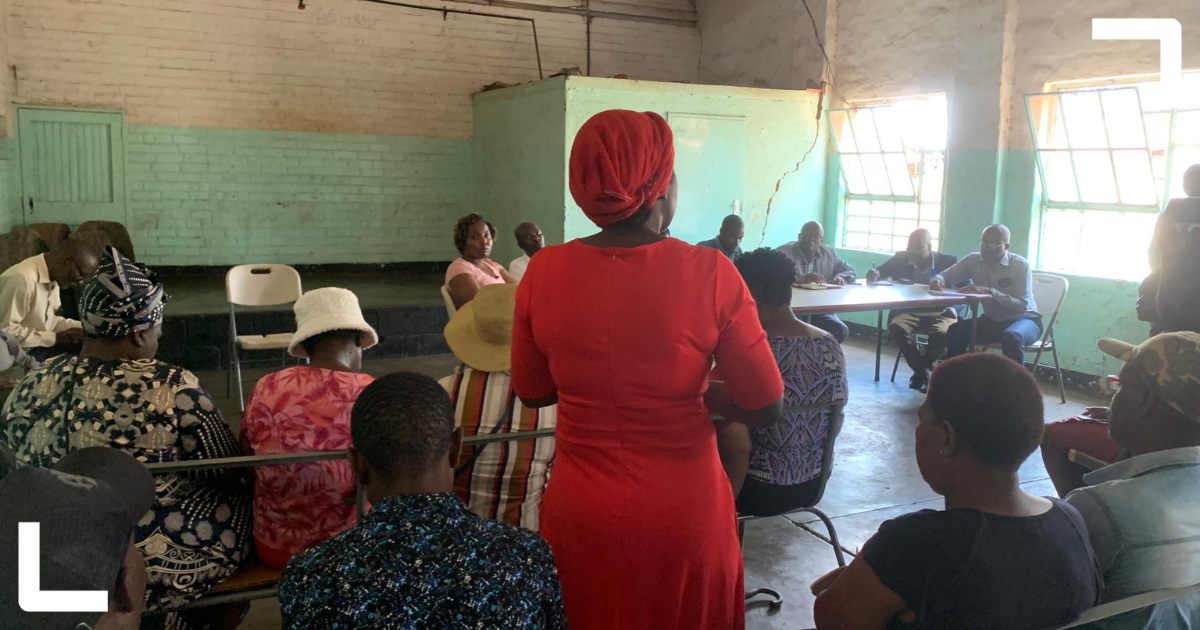
“I think one of the most important aspects that has come out of this space is creating that enabling environment where communities can interact with the state without necessarily throwing accusations at each other.”
In this episode, Chris Jordan and co-host Rosebella Apollo are joined by Harare-based practitioners George Masimba and Shiela Muganyi, from Dialogue on Shelter and Zimbabwe Homeless People’s Federation respectively, to explore what inclusive urban reform looks like in practice. They explore two ACRC action research projects that are currently underway in Harare – the first focused on upgrading urban markets, and the second on building climate change resilience among informal settlement communities.
Reflecting on the urban markets project, George talks about working with market associations across 13 sites in Harare, on elements including data collection, policy engagement, capacity strengthening and infrastructure upgrades. Building on an earlier project based in the Glen View 8 Furniture Complex, he explains how the action research is supporting traders to improve their livelihoods and build resilience in the face of repeated market fires. Shiela then discusses the Informal Settlements Climate Change Action (ISCCA) project, exploring how climate change has become a catalyst for informal settlement upgrading, improving tenure security and driving community-led action in low-income areas. They unpack the role of the Urban Informality Forum as a collaborative platform that brings together communities, city authorities and researchers, and talk about how it could be replicated in other African cities to drive inclusive reform.
> Read more about ACRC’s work in Harare
Chris Jordan is communications and impact manager for the Global Development Institute at The University of Manchester, and ACRC’s communications manager.
Rosebella Apollo is ACRC’s research uptake officer, based at the Partnership for African Social and Governance Research (PASGR) in Nairobi.
George Masimba is head of programmes at Dialogue on Shelter and ACRC’s city manager for Harare.
Shiela Muganyi is a community research leader from the Zimbabwe Homeless People’s Federation and part of the ACRC Harare action research project on climate resilience.
Transcript
The full podcast transcript is available below.
Read now
Chris Jordan Hello and welcome to the African Cities Research Consortium podcast. My name is Chris Jordan. I’m the communications manager with ACRC and today I’m joined as a co-host by Rosebella Apollo, our uptake lead in Nairobi. Welcome Rosebella.
Rosebella Apollo Thank you, Chris. I’m happy to be here.
Chris Jordan And we’re also in Manchester with some of the key people in our team from Harare. We have George Masimba who’s the head of programmes at Dialogue on Shelter. Hello, George.
George Masimba Hi, how are you? Glad to be here.
Chris Jordan Great, yeah, good thanks. We’ve also got Shiela Muganyi, also at Dialogue on Shelter, who is heading up the programme around informal settlements and climate resilience. Hi Shiela.
Shiela Muganyi Hi Chris, hi Rosebella, thank you for inviting us.
Chris Jordan Our pleasure. It’s lovely to have you here. So, we wanted to talk to you about some of the work that you’ve got going on in Harare at the moment and some of the surrounding issues. One of the longest standing projects that you’ve had, I think the first one you started, was around urban markets, which are a really key element of the city, providing livelihoods and an economic base for thousands of people. So could you tell me a bit about what the project set out to do and how it’s developed over time?
George Masimba Thank you very much, Chris. Indeed, the work that we’ve done in Harare started with the urban markets work, which I’m going to talk about, and we’ve also had a component around informal settlements, which my colleague Shiela will talk about. So in terms of the urban markets work, like you rightly pointed out, it was as a result of the realisation that markets play in the city in terms livelihoods. But also taking into account the, apart from these opportunities in terms of livelihoods benefits, there are also challenges in these markets, particularly with regards to access to infrastructure and services in these markets and also even the policies that relate to making these spaces more inclusive, more resilient and sustainable as part and parcel of the mainstream city. So, our projects sought to engage with the market associations from across the city of Harare and we targeted about 13 markets from within Harare, and the broad agenda around the project was to undertake what I would consider as three or four elements. So, firstly, it looked at data collection, taking into account that the work that we’re doing is part and parcel of the ACRC action research project. So data collection was a very key element in terms of trying to understand the realities of the markets in Harare. Secondly, there was also a huge component around policy-related processes. And what do we mean here? We were focusing on supporting policy-related engagement with the city in terms of identifying areas that require strengthening, in terms of ensuring that we have the right institutional environment where traders can flourish and the markets as well. And then thirdly, we also had a significant component that focuses on capacity strengthening in terms of the market associations, and also even capacity strengthening in terms of state institutions taking into account the theory of change of ACRC, which speaks to enhanced state capacity as one of the key pillars that unlocks inclusive urban growth. Then, lastly, we had a component around undertaking physical upgrades as a way of demonstrating what can be done in terms of improving these markets when traders, the city, and all the stakeholders come on board in terms trying to solve these issues. So that’s the focus, or that was the focus of the work that we’re doing in Harare. And we started with focusing on one market. Where we made some interventions in terms of the hardware related interventions and this is Glen View 8 Furniture Complex. It’s located towards the southwestern part of the capital of Harare. This, as the name suggests, the market is involved in carpentry items, but beyond that there are also related livelihoods activities that are also happening within the same market apart from the furniture making businesses. So we did collect data, supported by academics and also communities, taking into account the community knowledge component that is a very huge component in terms of the African Cities Research Consortium action research. And then after collecting data, together with the traders, we then sat down to reflect in terms of what was this data telling us. And in terms of the data, it told us about a lot of gaps with respect to infrastructure. And that speaks to issues of access to water and sanitation, for example, and also even drainage in the case of flooding during rain season. But also another element that was so profound or prominent in terms of the findings from Glen View relates to the perennial fire outbreaks that we have become accustomed to in terms of Glen View 8 furniture complex. And if I may say this, since the market was established in 2006, there’s been 15 fire outbreaks in Glen View. So part of the priorities that informed the interventions were hugely informed and influenced by some of these issues that were highlighted or came out of the data processes. And so we began a process of sitting down together with the city, because the the market is owned by the city. But there are also other critical stakeholders including the provincial and central government in terms of supporting SMEs or informal sector. So we worked out how we would then come up with the hardware interventions that sought to respond to some of these priorities identified. And we identified collectively together with the traders WASH interventions as some of the low-hanging fruits as it were that could be rolled out in terms of infrastructure upgrades. And to date I’m happy to note that that work was completed in the first phase. And apart from these hardware interventions, we also learned a significant amount of lessons in terms of what this is teaching us about markets. Despite issues to do with their contested nature, we noted that market associations, traders – they are willing to contribute towards addressing some of the challenges that are faced in these markets and willing in terms of ideas, willing and even in terms resources. But more often you find that there are no opportunities for the different stakeholders to come onto the same table and chart some pathways for bringing these required services into these markets. So that’s something that we have learned through this process, through the ACRC action research in Harare. And just to also note that, apart from Glen View, there were also related interventions that we undertook that touched other markets beyond just the Glen View Furniture Complex. So, for example, the policy engagements that I spoke about earlier involved other markets, in terms of ensuring that whatever institutional frameworks that would be in place would also then enable establishment or supporting markets just beyond the one that had been targeted. And even the learnings, we had opportunities for peer-to-peer learning across these different markets, learning from each other in terms how they were addressing or resolving some of the challenges that they are facing in their markets. And we had an exchange visit with Bulawayo, which is the second capital in Zimbabwe, where Glen View traders were able to also see some of the governance approaches that were being used in terms of administering similar markets. So really, quite a number of lessons that we took away from the first phase and which we hope are going to be very useful in terms of informing the way that lies ahead, in terms of the phase two that is just starting now. And we have plans to, having done Glen View, we have plans to sit down together with the City of Harare and relevant stakeholders in terms of which other markets can we get into. And also supported by the lead for the action research project, which is Development Governance Institute. So that’s what we have done, that’s where we are in terms of the urban markets project, and yeah, we are happy we are here, we are happy we have learnt some considerable amount of lessons through this action research project.
Chris Jordan That’s really fascinating to hear and I know you mentioned the fire outbreaks that regularly happen at Glen View, but also part way through the research that you were doing, there was a major fire at the main urban market, the Mbare market. Did that create opportunities for you? Did it open more space or dialogue around the issues of markets more broadly?
George Masimba Thank you Chris for that question. Indeed, in as much as the fire was very unfortunate, as would always be the case, I think it also presented opportunities for engaging the state. For example, soon after the fire, we were able to facilitate hosting of a policy seminar that drew the city and central government and many other relevant stakeholders together around the Urban Informality Forum, which is a platform that we co-created together with our partners and hosted within the University of Zimbabwe. So, we were able to come up with a policy seminar that specifically focused on disasters in urban markets through, as a result, or following the outbreak at Mbare. And this helped in terms of spotlighting the disaster-related challenges that are faced in urban market and begin to push the key stakeholders, in this case, city and central government authorities, in terms of how do we ensure that markets become resilient against the backdrop of such incidences as the perennial fires that continue to affect markets in Harare? So it indeed provided an opportunity to have some conversations and make out some strategies in terms of how do you support markets so that they become fire resilient, as it were.
Rosebella Apollo Thank you very much, George. Perhaps, just to take us slightly back, I wonder – traditionally, Dialogue on Shelter has focused heavily on engagements with informal settlements and informal settlers. This switch now to working with the urban markets. How do you transition very seamlessly? Like you rightfully put it, you have managed to switch the different sides from the informal settlements to the market and have successfully still put up quite some tangible interventions. How do manage to seamlessly transition, but most importantly, how do you make the inroads for that kind of change?
George Masimba Thank you, Rosebella, for that question. So indeed, the urban markets space and the informal settlements space are two different things, but they are also similar in the sense that you are dealing with informal spaces. So, that informality component or element contributes to our capacity to then transition from this one space to the other, because in many respects, some of the realities or the challenges that they are dealing with are more or less the same. So, you talk of informal settlement, issues of infrastructure gaps are very common, and the same applies to markets, particularly if they are informal and even formal markets. So that common thread in terms of informality running through these different spaces helped us to get around that transition and to be comfortable in terms for dealing with this new space that we were entering into. But I also want to note that we learned a great deal of lessons working with informal markets in terms of how you need to adjust some of the tools and strategies, approaches that you deploy in informal settlements. For example, previously when you are undertaking data collection in informal settlements, the notion of time does not come very much on the forefront, but when you’re dealing with traders and you’re conducting research, time becomes money. And that’s one thing that we learned and it informed the way we’re undertaking data collection processes, taking into account that you are dealing with people whose time is essentially money. So you’ve got to then respond accordingly or adjust accordingly in terms of how you approach the data collection processes, but even the mobilisation processes, all that needs to respond to this different context in terms of markets. So yeah, it was indeed a different space, but we also took a number of lessons in terms of how we could approach that.
Chris Jordan Great and this work, as you said, is ongoing. There’s more to come. Where would you like to get it to? Where do you think the opportunities for reform and improvements around markets are in Harare?
George Masimba So, in terms of opportunities for reform in Harare, they pointed at many things and in terms of what I could talk about right now is how do you leverage traders’ resources in terms of ensuring that markets are upgraded? Because I think, based on the findings, it’s an area that is full of missed opportunities in terms of how traders can contribute towards improvement of their trading spaces, which is something that we are borrowing and learning from the informal settlements space, where communities take a huge part in terms of contributing towards upgrading. And we think there is merit in replicating, of course, adapting that model into markets where you leverage on their resources, both in terms of financial resources, as well as their intellectual resources, in terms how markets can be improved. So that’s an area where we think there is a lot of potential for reform, and we are happy to note that in phase two, a huge focus of our work will look at how do you come up with alternative infrastructure and land tenure models for markets in Harare – the work that is going to be led by Development Governance Institute. And that for us provides the basis and foundation for thinking through processes related to policy reform that respond to the broader agenda that ACRC is pursuing in terms of pushing inclusive urban reform. So, one, land tenure. Two, infrastructure financing in terms of the contribution of traders.
Chris Jordan Thanks, George, and we might come back to some of those broader issues of reform and coalitions and how change is being moved forward in the city, but can I now turn to you, Shiela? So can you tell us a bit about the project that you’re leading around climate change and improving resilience within informal settlements?
Shiela Muganyi Thank you so much, Chris. So the ISCCA project, the Informal Settlements Climate Change Action project, is using climate change as an entry point to slum upgrading in Harare. So at the same time, it’s also strengthening the locally-led adaptation actions that are already happening in the communities and also building the city’s capacity to implement its own framework in terms of slum upgrading. So this is what ISCCA is trying to focus on in Harare’s informal settlements and city-wide.
Chris Jordan And what have you done so far? Has this been research on the ground in terms of looking at different solutions or what’s happened?
Shiela Muganyi Yes, so what we have done so far in the first phase, we have done vulnerability assessments. So the first phase was mainly on research and now we are focusing, this is our second phase, we are now focusing on action, on the action bit. So we have done the vulnerability assessments, we’ve done the mapping, trying to map the hazards, the risks in the communities. And also trying to understand what really happens, what are the causes of these impacts. And then we also developed, we co-developed the communities’ climate change action plans and these are the actions that they are also using to do the locally-led actions in their communities. And also they are using these to also advocate for slum upgrading of their communities. So, for example, the main issue in the communities that’s been coming out, despite the climate change impacts is the issue of tenure. And that’s the biggest challenge that’s preventing the communities themselves to do a locally-led action that can be long-term. Most of the communities are focusing on short-term actions. So the project now is coming in to try and have these conversations with the city, at least for them to understand what’s happening on the ground, the actions that are being done, and also the efforts of the communities to be embedded in the city’s framework. And also, we have been trying to do Urban Informality Forums that bring together the state, the local authorities, different other actors that are relevant to the work that we are doing. So in December on the 5th, we held an Urban Informality Forum, which was mainly focusing on Dzivarasekwa Extension towards other road designs. So this also we made sure that we brought the state to the grassroots because if we looked back, when we used to do these Urban Informality Forums, we used to have meetings in spaces like this, in spaces at the University of Zimbabwe, in spaces at the City of Harare Chambers, and then this time we shifted from that because we want the city to be involved in the plans, in all the action or the work that the communities are doing, and also see how they can support them around the challenges that they are facing. So this is also one of the things that we have done and achieved. And also, in the first phase, we had a project management committee, which is in partnership with the City of Harare, Zimbabwe Homeless People’s Federation, and Dialogue on Shelter. And some community representatives also managed to be part of these conversations. So the main purpose of this project management committee, it was established around 2010 during the Harare Slum Upgrading Project. So we revived it when the ISCCA project came. So what we achieved from the first project management committee meeting that we held in May last year was the relevant departments of the city of Harare then came in to support Tafara’s informal settlement by issuing them a partial compliance certificate. They also issued them with lease agreements that they are in the process of signing and also approved house plans. So this is a process that’s still in place and almost 75% of the communities managed to sign their lease agreements and to have their own approved house plans. So this was the main achievement or a milestone from this project management committee that we can still embrace. And then, Tafara informal settlement, now we started to do permanent construction on the ground so right now I think it’s plus or minus 30 houses that have been built to roof level. Right now, work is in progress, they’ve been sending photos of what’s happening right now, so this is a milestone for us. And we also had another meeting on the 27th of February, another project management committee some two weeks ago, and we also then tried to see how we can also work into the 11 settlements that are focused by the ISCCA project. So there is a process of regularisation that’s happening in the city of Harare right now. And the relevant department, also one of the main officials, then asked us if we can meet and then also see which of the settlements that we are planning to work with or we are working with so that we can try and see how we can work together with the city of Harare. And right now, in that same meeting, they also reported that they have started regularising 150 informal settlements in Harare, so it’s one of the, during the Harare Slum Upgrading Project, I think we managed to sign a memorandum of understanding between us and the city of Harare, and from this we then produced a slum upgrading strategy, where there are some issues of regularisation policies inside this. So I think they have also started to institutionalise or operationalise the strategy that we produced together. So these are some of the milestones here. I can also talk about the settlement to settlement visits that are ongoing, which are also have been very helpful between the communities, and also another milestone is that the communities themselves are speaking directly to the theory of change reform coalition. The settlements themselves then decided to establish an informal settlements network, which they use as a platform of sharing ideas, sharing concerns, sharing what’s happening in real-time on their settlements. And this informal settlements network has proved to be one of the networks that’s been very helpful in these communities. By that, it was an informal settlement network that started as 11 settlements, only that are focusing on the ISCCA project, but it has now gone beyond the 11 settlements and now we are calling it a city-wide informal settlements network.
Chris Jordan That’s really great and loads that’s happened. I’m really interested in that originally, this was a project that used climate as its focus and its entry point, but it seems like a lot of the positive changes that you’ve seen have been around regularisation and tenure security and some of the bigger, you know, possibly like harder things to achieve around this sort of process. So how’s that worked? Is that just the City of Harare recognising that in order to improve time and resilience, that tenure was a precursor to that?
Shiela Muganyi Yeah, so just because we are having these regular meetings, regular conversations, I think there are a lot of, there are series of conversations or engagements that we’ve been doing, bigger meetings, smaller meetings, you know, with the city of Harare. So I think it is something that the city is embracing. It’s something that the city has also started to look at on another lens. And the other thing that I think is making this relationship stronger between the communities and the City of Harare is that through the Urban Informality Forums and the meetings that we do together, including the affected community representatives, they speak for themselves in these communities. Now they even know that this is the Office of the Surveyor. This is the Office of the Housing Director. They are even known by their names. So I think it’s something that we’ve seen as a catalytic, it’s catalysing, it is trying to speak to what the project’s focus is on.
Rosebella Apollo Perhaps Shiela, you’ve spoken rightly of the involvement of the City of Harare in the processes of the ISCCA project and the bigger reform around regularisation in Harare. I wonder, the Urban Informality Forum has transitioned from being in the university and formal spaces, and now you have brought it to the community. How has that landed? What kind of effects are we seeing in terms of that engagement with the community members, now that the Forum is closer to the community?
Shiela Muganyi Thank you, Rosebella, for that. I think the first achievement for us is actually to bring the state, the ministry, or the minister of state to the ground. And meeting the community and exchanging, I can say, positive conversations. So this is one of our achievements, because it is very hard, especially to bring the ministry down to the people. And then secondly, like I said, the last that we had, it was on the 5th of December 2025. And this was focusing mainly on the designs of the Dzivarasekwa Extension road, which is very damaged by the floods, there are no proper drainage systems in the community. So at that time in December, it was raining in Harare. And so when they came, the roads were flooded, they could not even see where to step when they’re walking. So it was kind of something that had an impact. So the City of Harare and the ministry then came back after this meeting and also tried to have dialogues with the specific community. So there are road designs that are in place right now, and the City of Harare is also trying to help with this organisation that’s helping the City to put in place the designs. The designs are now there, but they are not yet approved. So it’s something that we are seeing, we are just waiting for the approval of the designs, and if they are there, then maybe we can now see how to support the community. Because Dzivarasekwa Extension has already started contributing savings towards the road. So they are just waiting maybe for the designs. And the other thing is that the community itself has had a meeting with their own councillor, the politicians of the community, the ones who also sometimes we say them, these, they call the shots. So they are always being part of the meetings that we hold with the communities. And so the last meeting that we had, the community then agreed to start cleaning wherever they are supposed to start. They started to do any other job that they are supposed to do in preparation for the main work. So this is what’s happening. And so I think just because of the commitment of the state themselves and the local authority in this and also their attendance in our meetings shows that at least we have some pathway.
Chris Jordan And I’m also quite struck by the fact that in both projects, the Urban Informality Forum seems to have played a really crucial role in helping to bring together state, communities and researchers, and has played an important sort of catalytic first stage. Could you just tell us a little bit more about the Urban Informality Forum, George, and where it came from and how it operates?
George Masimba Thank you very much, Chris, for the question. So the history of the Urban Informality Forum can be traced back to 2018, when we created this space together with our colleagues, the Development Governance Institute, ourselves, Dialogue on Shelter, Zimbabwe Homeless People’s Federation, the Shelter and Homage Trust and the University of Zimbabwe’s planning school. So the logic around creating this space, we looked at it as a learning and policy space, really. The logic being to create some platform that allows for neutral conversations, if I can put it that way, where communities, the state and civil society actors have got the opportunity to talk about what is not working within the city, without necessarily pointing fingers at each other. So we thought the university as a convening space allowed us to engage in these less contested conversations around how do we think of, how do make our cities work, what is needed in terms of policies for our cities to work? So that’s when we established that space and we would identify themes of interest related to informality, various themes of interest related to informality. For example, issues to do with participatory slum upgrading were discussed in some of the earlier seminars. Issues to do with climate change, climate resilience have been discussed. Issues to do with evictions also, stuff that would not normally be conversed with the state and communities on the same table. But we created this platform that allowed people to reflect on their experiences of the city, particularly from an informality lens, if you want. And to date, we have held plus or minus 15 sessions or seminars that have seen officials from the local government, central government, making presentations alongside communities and academics in terms of what needs to be done to make our cities more inclusive, more sustainable and more resilient. And like Shiela indicated, we have also over the last years extended the geography to informal settlements, where all these challenges that we are talking about are being faced. So getting your academics, students also from the universities and officials from the state to get a chance of having this first-hand experience with some of these challenges that communities are encountering in their settlements. But I think one of the most important aspects that has come out of this space is creating that enabling environment where communities can interact with the state without necessarily throwing accusations at each other. A space that allows to present some learnings, ideas from other jurisdictions in terms of what has been tested, what has worked elsewhere, and how it can be adapted in our own local context and come up with solutions that are not only inclusive, but solutions that provide lasting solutions to the challenges that communities are facing. So, that’s the history of the Urban Informality Forum in Harare, and we think we are not there yet, but so far we are very excited about the progress that we have registered through this platform that we call Urban Informality Forum.
Chris Jordan That’s really interesting to hear and I know you’ve inspired lots of other ACRC city teams, our colleagues in Lagos are looking at the moment about how they might be able to set up something similar. Do you think it is an approach that might be useful across other African cities?
George Masimba Yeah, I think it’s an approach that might be very useful in other African cities and it resonates with the approach and logic within ACRC which encourages collaborations between universities, civil society organisations, communities and the state. So I’m imagining, given the the kind of partners or stakeholders that we have under ACRC, where we have different higher institutions of learning collaborating with civil society organisations, it would be very easy to replicate, but of course adapt based on some of the contextual realities in the different cities, under ACRC. I’m imagining that it’s a concept and approach that can be easily replicated elsewhere and provide opportunities for pushing and advancing inclusive urban reforms in African cities.
Rosebella Apollo Perhaps, George, you have rightfully stated that the context across African cities really differs and might be different. Should other cities be interested in setting up, what are some of like the quick reflections around the basics that they need to do to get an Urban Informality Forum?
George Masimba Thank you very much, Rosebella. I think I will refer to an article that I wrote last year that speaks to our experiences around the Open Informality Forum. And I think one of the things that I would do, think is important, it relates to the geography, where you convene these seminars, matters. And we started with the university, we think that was very strategic, because it provides that neutrality in terms of enabling conducive engagements to be undertaken between different parties around inclusive urban reforms. That’s one. Then two, I think it’s also about how you ensure that you deal with power dynamics around ensuring that community voices are given an opportunity to be highlighted and amplified in these spaces, because you risk excluding communities, bringing them on board but excluding them at the same time, if you are not careful about the issue to do or respond to power dynamics that come with the different stakeholders that we are talking about. So that’s the second thing, that sensitivity to power-related issues. Then three, there is also need to take into account the urban politics of the city. I think there’s need to be conscious of the dynamics related to the urban politics of each and every given city that you are working in, so that you also approach the space in ways that will enable meaningful, honest conversations, that will give rise to the inclusive urban reforms that we are talking about. So that element is also key in terms of for those cities that may be interested in experimenting with this idea. But I should also hasten to point out, a lot will also depend on what organically emerges from these processes in terms of what should be the best pathway for establishing a sustainable platform for honest engagement among different parties around urbanism.
Chris Jordan Well, it will be fascinating to see whether any of the other ACRC cities can get something similarly effective going. So we will track that carefully. And I’ll make sure that that paper that you mentioned is linked down in the show notes. And it is also part of a wider special issue on reform coalitions that covers a lot of the ground and a lot the issues that we’ve been talking about more broadly today. But yeah I just want to say, George and Shiela, thank you so much for joining us today, thank you for sharing your insights. Rosebella, thank you as well.
Rosebella Apollo Thank you very much. It’s been an insightful conversation.
Chris Jordan And we will look on with care to see what happens next in Harare. Good luck guys!
George Masimba Thank you, Chris, thank you, Rosebella, for having us here. Bye!
Outro You have been listening to the African Cities Podcast. Remember to subscribe for more urban development insights and interviews from the African Cities Research Consortium.
Header photo credit: Dialogue on Shelter Trust. An informal settlement resident engaging city officials at an environment and climate policy consultation in Harare.
Note: This article presents the views of the author featured and does not necessarily represent the views of the African Cities Research Consortium as a whole.
The African Cities blog is licensed under Creative Commons Attribution-NonCommercial-NoDerivatives 4.0 International (CC BY-NC-ND 4.0), which means you are welcome to repost this content as long as you provide full credit and a link to this original post.
