By Peter Elias and Temilade Sesan
African cities are changing fast. They are expanding, absorbing new populations, confronting climate risks, and struggling with long-standing gaps in housing, infrastructure, health, sanitation and basic services. In many places, the pressures of urbanisation collide with flooding, heat, air pollution, biodiversity loss and deep social inequality. These challenges are too complex for any one institution, discipline or government agency to solve alone.
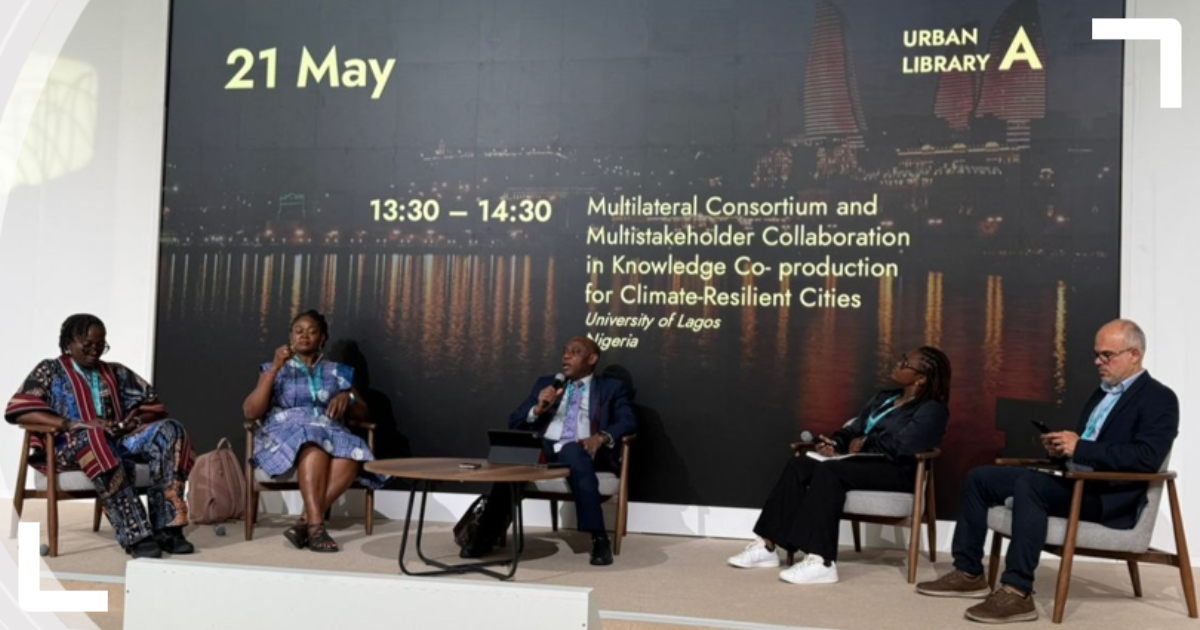
This was the central message of the WUF13 Urban Library session titled “Multilateral Consortium and Multi-Stakeholder Collaboration in Knowledge Co-Production for Climate-Resilient Cities”, convened by the Centre for Housing and Sustainable Development, University of Lagos. The conversation brought together representatives from international research consortia, academia, government and public health to reflect on how African cities can become more inclusive, evidence-informed and climate-resilient.
At the heart of the discussion was a powerful idea: technical knowledge alone is not enough to solve the climate conundrum. Data, maps, models and scientific tools are important, but they must be connected to lived experience, public policy, community priorities and practical action. In other words, the future of climate-resilient cities depends not only on producing knowledge, but on producing it together.
Making invisible communities visible
A major message of the session was the need to make informal and deprived communities more visible in urban planning. Many African cities contain settlements that are poorly represented in official data. Roads may be unnamed, houses unmapped, services undocumented and risks underestimated. When communities are invisible in data, they often become invisible in policy and investment decisions.
The IdeaMaps Network was presented as one effort to address this gap by using spatial data, community knowledge, artificial intelligence and participatory methods to map deprivation and informality. Such mapping can reveal where people lack access to healthcare, roads, drainage, sanitation and other essential services. It can also help identify communities most exposed to flooding, poor environmental conditions and climate-related hazards.
But the panel also warned that data must not become an end in itself. One community voice captured this clearly: communities do not only need data; they need change. For residents living with flooding, poor sanitation, unsafe water or threat of eviction, the value of evidence lies in whether it improves their lives. Data must therefore move from visibility to action.
From research to reform
The African Cities Research Consortium (ACRC) highlighted the importance of reform coalitions: groups of actors who come together around shared urban challenges to pursue practical change. These coalitions may include researchers, civil society, communities, government agencies, students, private actors and development partners.
The value of such coalitions is that each actor brings something different to the table. Academia contributes research and evidence. Government brings planning authority and policy mandates. Civil society brings advocacy and community trust. Communities bring lived knowledge. Development partners may provide resources and platforms. When these strengths are combined, urban reform becomes more possible.
One of the panellists cited an example from Mukuru, Nairobi, which shows how collaboration can move beyond research into concrete improvement. In that example, collective action helped resist forced eviction and later supported efforts to improve access to water and sanitation. This illustrates that resilience is not only about infrastructure; it is also about rights, dignity, tenure security and the ability of communities to shape their own future.
The role of academia
Academic institutions have a critical role to play, but that role must go beyond writing reports and publishing papers. Universities and research centres can serve as bridges between evidence, policy and lived realities. They can help interpret data, validate models, document local knowledge and translate findings into policy-relevant formats.
The experience from the Africa Centre for Excellence for Population Health and Policy (ACEPHAP), Bayero University, Kano showed how research can become more meaningful when communities shape the agenda. Initial work on mapping informal settlements evolved into a focus on access to maternal health services after community engagement revealed this as a priority. This is an important lesson: locally grounded research must be flexible enough to respond to what communities identify as urgent.
Academic institutions also provide continuity. Donor-funded projects may end, but universities and local research centres can remain as long-term anchors for knowledge, partnership and institutional memory.
Government needs practical evidence
From the government perspective, planning begins with data, according to the Lagos State Ministry of Physical Planning and Urban Development. Policymakers and planners need socio-demographic information, spatial data, environmental evidence and clear records of existing services. They need to know who lives where, what risks exist, what services are missing and which groups are most affected.
However, evidence must be presented in forms that government can use. It must connect with planning cycles, budget processes and institutional mandates. A good report is not enough if it does not speak to implementation. This is why continuous engagement between researchers, communities and government agencies is essential.
Evidence must help answer practical questions: Where should investments go first? Which communities are most vulnerable? What services are missing? Which agency is responsible? What funding source can support implementation?
Communities as partners, not data sources
Perhaps the strongest message from the session was that communities must not be treated merely as respondents or sources of information. They are partners in knowledge production.
Community-based movements such as the Nigeria Slums/Informal Settlements Federation know their realities in ways that outsiders often do not. They understand flooding patterns, water levels, local hazards, social networks, survival strategies and service gaps. Exchanges between the panel and members of the audience revealed how, in Makoko, for example, residents may not be able to describe their experiences using technical climate language, but they understand water, tides, risk and adaptation through daily life.
These reservoirs of local knowledge must be respected. Planning should no longer be about doing things “for” communities but doing things “with” communities. When people are involved from the beginning, interventions are more likely to reflect real needs and gain public trust.
Avoiding extractive partnerships
The session also addressed the danger of extractive research, where international or external actors collect data from communities without leaving meaningful benefits behind. To avoid this, partnerships must be built on dialogue, fairness and local value.
True dialogue means listening carefully, adapting priorities and recognising that not all knowledge comes from subject-matter experts. It also means producing outputs that non-scientific communities can use: maps, briefs, workshops, community exchanges, policy notes, blogs and practical tools, and not only academic articles.
Knowledge co-production should leave behind stronger local capacity, better relationships and evidence that communities and governments can use beyond the life of a project.
The way forward
The discussion ended with a clear call: collaboration must be institutionalised. Too often, partnerships begin and end with donor-funded projects. But climate resilience requires long-term relationships, local ownership and continuous engagement.
African cities need participatory governance systems where evidence, community voice and policy action are connected. They need stronger local government ownership, better inter-agency collaboration and deeper trust between institutions and residents.
For academia, the task is to produce knowledge that is rigorous, relevant and responsive. For policymakers, it is to turn evidence into inclusive planning and investment. For civil society, it is to sustain accountability and amplify community voice. For communities, it is to continue asserting lived experience as legitimate knowledge, ideally with the support of dedicated reform coalitions.
The future climate-resilient city will not be built by data alone. It will be built through shared knowledge, shared responsibility and shared action. It must be not only smart and sustainable, but also just, inclusive, visible and people-centred.
Photo credits: World Urban Forum
Note: This article presents the views of the authors featured and does not necessarily represent the views of the African Cities Research Consortium as a whole.
The African Cities blog is licensed under Creative Commons Attribution-NonCommercial-NoDerivatives 4.0 International (CC BY-NC-ND 4.0), which means you are welcome to repost this content as long as you provide full credit and a link to this original post.
