
80% of urban workers in sub-Saharan Africa are employed in the informal sector and the vast majority work in household microenterprises (HMEs). They are so called because the owner-operator supplies the labour (sometimes alongside other family members) and usually based within the home.
A new paper, led by Stephen Gelb, outlines key findings from ACRC’s neighbourhood and district economic development domain research, which looked at HMEs in five African cities: Accra, Ghana; Lagos, Nigeria; Dar es Salaam, Tanzania; Lilongwe, Malawi; and Harare, Zimbabwe.
What does progress look like for HMEs?
The paper argues that “progress” for HMEs is not reflected in better income levels or reducing poverty/inequality at the city scale, but that it involves both the routinisation (stability and predictability) of activities and also security (regularity and permanence) of income – at both the level of individual enterprises and groups of HMEs.
This does not only concern revenues, but also direct and indirect costs for infrastructure and finance, as well as governance arrangements, bargaining power and HME owners’ time – which is especially crucial in small firms.
Understanding HMEs’ productivity challenges
Much existing literature focused on the informal sector and HMEs tends to focus on individual challenges facing these firms, without looking at the interaction between factors and how they are shaped by the political economy of a city. As such, the paper develops a coherent framework for analysing HMEs as firms, bringing together six issues which shape HMEs’ activities, but are often analysed in siloes.
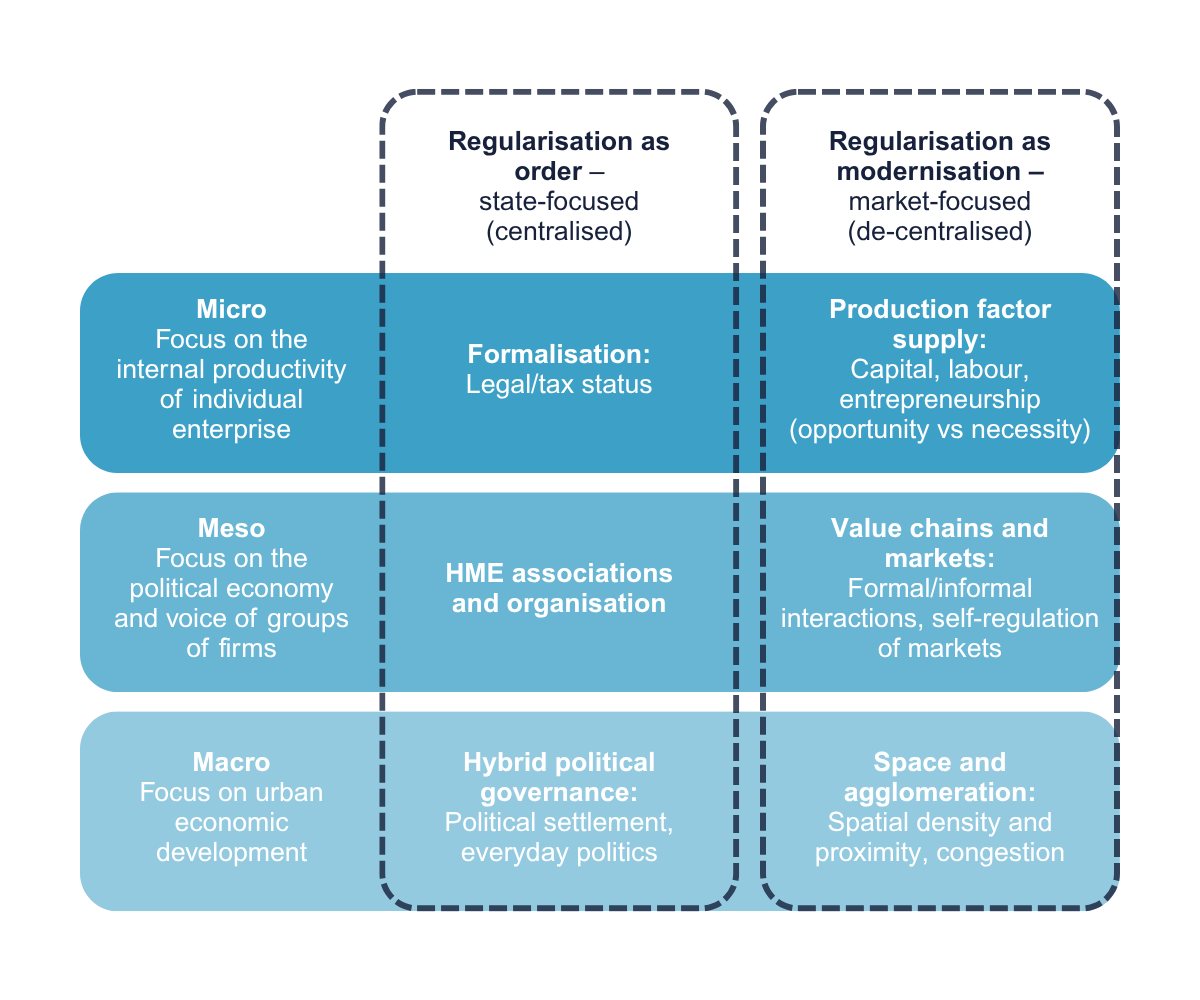
Going on to examine each dimension in detail, the paper emphasises the importance of industrial sub-sector and spatial location in shaping how each dimension impacts an HME, using examples from the research across the five cities. In summary:
1. Formalisation – Critiquing the standard view that informality is chosen by HMEs, the paper argues that state-imposed formalisation, construction and management of market spaces are impractical. HMEs ignore formalisation, taxes are not collected, and HME locations are shaped by customer patterns rather than state orders.
2. Factor supplies – Aside from micro finance institutions, informal savings clubs and mobile money, HMEs often face financial exclusion, forcing them to rely on informal moneylenders. Ecosystems of interdependent institutions, policies and organisations that share a common purpose are therefore needed for both entrepreneurial training and financial literacy, but different ecosystems are needed for different types of HME.
3. Hybrid governance – Formal and informal rules and regulations co-exist for HMEs, with both based on the threat of violence. Informal groups including gangs, political party members or traditional authorities impose charges or “transfer rents” on HMEs – as often do formal state-linked agents, in addition to official fees. Some informal regulation systems, such as market queens in Accra, may also hold legitimacy for HMEs and residents.
4. Agglomeration – Literature on agglomeration in African cities tends to focus on congestion and its impacts – directly on productivity, and indirectly on health, crime and land values. But recent analysis showing that agglomeration benefits exist applies to HMEs too, as seen with sub-sectoral collocation in both services and manufacturing. The reasons include sharing (collective input acquisition), matching (lower transaction costs for customers and manufacturers), and learning from knowledge circulation (usually within sectoral clusters).
5. Value chains with larger firms – HMEs interact extensively with formal firms – both vertically in the same value chain (VC), and horizontally across a single product market. Many HMEs will be pushed towards codified business practices through VC inclusion, while their role in formal sector VCs may affect the latter’s profitability. HMEs have limited power over input and output pricing, and while their negotiation power is linked to their potential switching costs, those organised within a VC can jointly press for greater benefit.
6. HME organisation – While many national, regional or city-based HME associations have large membership numbers, they are not well-consolidated or strongly representative of HMEs. Their policies tend to be “lowest common denominator”, rather than specific to different members’ needs. The paper argues that “indirect formalisation” through registering highly localised networks could be a more useful way to address issues around infrastructure, market spaces, financial inclusion, public tenders and everyday politics.
Strengthening policy around HMEs
In each city, many people continue to earn their livelihoods by running HMEs or working for HMEs run by family members – and there is no sign of this changing significantly in the near future. HMEs provide an important service to consumers in their neighbourhoods, helping them to manage poverty. There is also a strong gender dimension, as women tend to run these enterprises out of necessity.
The paper argues that we need to look at HMEs not as a homogeneous group, but in a more differentiated way. This involves not only distinguishing HMEs from larger firms, but also from each other – in terms of sector, spatial location and gender, as well as their approach to risk and their markets. A “one-size-fits-all” approach cannot work across a whole city; instead, a “bottom up” approach is needed to inform policy and shape successful outcomes for HMEs.
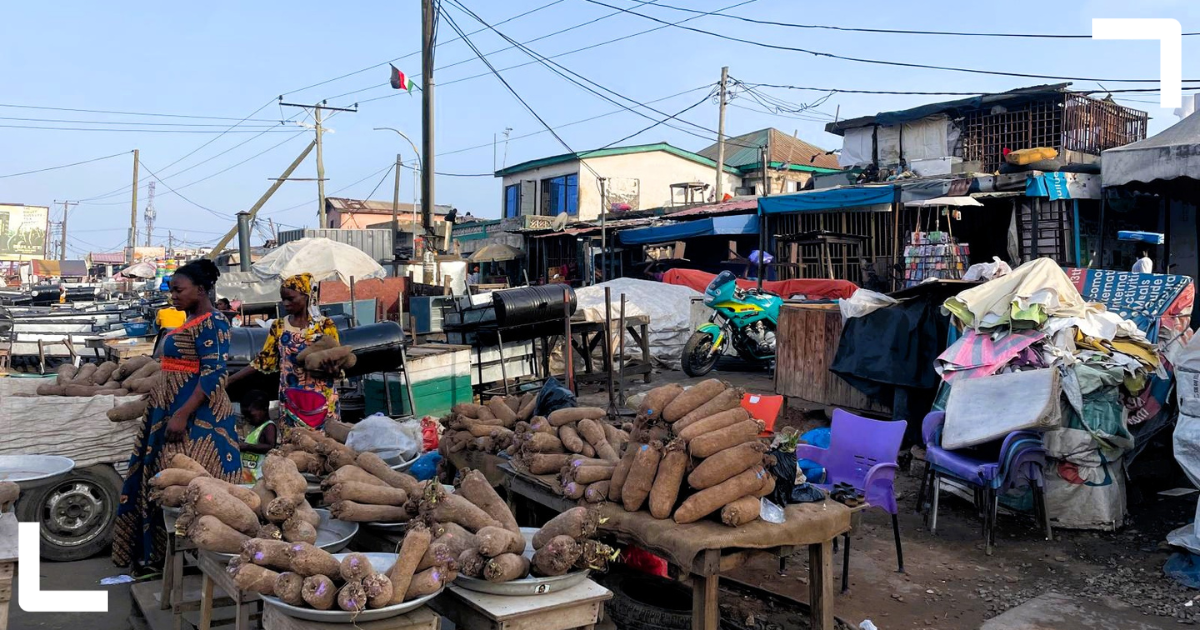
Header photo credit: Diana Mitlin. Market stallholders in Accra, Ghana.
The African Cities blog is licensed under Creative Commons Attribution-NonCommercial-NoDerivatives 4.0 International (CC BY-NC-ND 4.0), which means you are welcome to repost this content as long as you provide full credit and a link to this original post.
