By Jerry Okal, Susan Mwanzia and Ismail Ibraheem
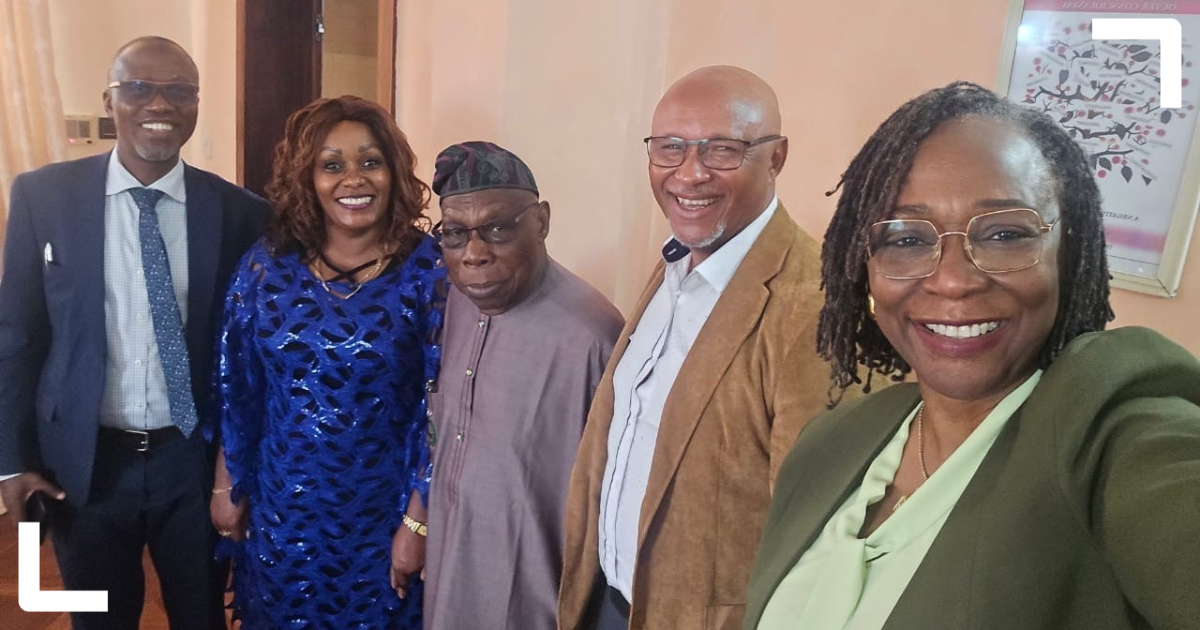
On Wednesday 6 May, ACRC colleagues met with the former Nigerian President Olusegun Obasanjo at his Presidential Library in Abeokuta. The meeting was timely and insightful, and it turned out to be far more than a courtesy visit.
President Obasanjo spoke with enthusiasm and passion about Africa’s progress, missed opportunities, countries and cities getting it right, the true meaning of elite commitment, how to engage them and what happens when research and politics fail to meet the people they are supposed to serve.
It was a conversation that touched on one of the most pertinent questions facing Africa today: how are politics and development connected, and what does it actually take to build countries, cities and a continent that work for everyone?
Those in attendance included Folasade Tolulope Ogunsola, vice chancellor of the University of Lagos; Ismail Ibraheem, ACRC uptake director; Susan Mwanzia, ACRC Nairobi in-city politics lead; and Jerry Okal, ACRC Nairobi uptake lead.
The role of conflict resolution in Africa’s development
Africa’s development story cannot be told without reflecting on its political landscape. Across the continent, the promise of economic growth, social progress and urban transformation has often been hindered – not by a lack of resources or ideas, but by political instability, electoral contestation and unresolved, prolonged conflict, such as the case currently in Sudan.
The evidence shows that countries that invest in peaceful political transitions and conflict resolution consistently outperform their peers on virtually every development indicator – from infrastructure investment, to health outcomes, to foreign direct investment.
This is precisely why the role of respected voices remains crucial on a continent prone to fragile political systems and political uncertainty. President Obasanjo himself has been at the forefront of advancing peaceful transitions on the continent. Most recently, he played a critical role in mediating the post-election tensions that followed Kenya’s 2022 general election – facilitating dialogue between President William Ruto and the late opposition leader Raila Odinga, at a time when the country was on the brink of political turmoil. That intervention helped restore peace and preserve the conditions for governance and continued development at a time of grave national uncertainty.
This is a reminder that conflict resolution is not a soft add-on to development – it is a key ingredient to moving countries forward. You cannot build a country, city, empower a community or sustain a reform coalition in the midst of political instability.
President Obasanjo brings a deep understanding of the political terrain and has built a high level of trust through decades of direct engagement with various heads of state, politicians, governments and civil society across the continent. Hence, he is well placed to foster dialogue, influence strategy and decision-making, and strengthen high-level collaboration in ways that institutional channels alone might not achieve.
Political stability as the foundation of African progress
The importance of political stability to Africa’s development cannot be overstated. When there is political instability or conflict and governments are consumed by survival, citizens suffer and are more preoccupied with safety than prosperity. And the chance for development and investment simply diminishes. Ideally, research, urban planning, community mobilisation and policy reform all require peaceful conditions to take place.
The meeting reinforced something that development practitioners often understate: that in African contexts, development outcomes are shaped not only by formal institutions, but also by relationships, networks and the ability of influential key actors to convene and mobilise different constituencies around a shared vision. Political settlements are complex, and navigating them requires the kind of nuanced, trust-based engagement that figures like President Obasanjo have spent a lifetime cultivating.
ACRC’s work across African cities is premised on precisely this understanding. Building coalitions – between citizens and elites, research and practice, community organisations and local government – requires a political environment in which those relationships can be nurtured over time. President Obasanjo’s long view of African development, shaped by decades in government, diplomacy and post-political engagement, gave the ACRC team a better appreciation of what building coalitions and meaningful and lasting change demands.
With communities, not for them
Throughout the wide-ranging discussion, one message came out clearly: real change is not done for people. It is built with them. Elite commitment, however genuine, is not sufficient on its own. Research findings, however rigorous, gather dust without community ownership. Policies, however well designed, fail without the people they are meant to serve being active participants in their design and implementation.
President Obasanjo’s emphasis on community empowerment alongside elite coordination reflects a deep understanding that enduring transformation requires both top-down political commitment and bottom-up community approaches and engagement. Neither alone is enough. Sustainable urban development demands that institutions and citizens move toward shared goals together – not in parallel or in sequence, but in genuine partnership.
This is not a new idea. But hearing it from a man who has seen it all and has been President of Africa’s most populous nation, brokered peace across the continent, and spent decades promoting development across the continent gives it renewed weight. And it is, of course, the foundational logic of ACRC’s own theory of change.
ACRC’s theory of change
The discussion with President Obasanjo did more than affirm ACRC’s direction – it actively reinforced the importance of the four pillars of ACRC’s theory of change and its conceptual framework. These pillars – which guide engagement, collaboration, evidence-based action and sustainable impact – provide the foundation for ACRC’s approach to addressing urban challenges across the cities where it operates. They exist to ensure that no community is left behind in the process of transformation.
What emerged from the meeting is a recognition that ACRC’s theory of change is not operating in isolation. It is a complementary approach and a potential driver within the broader push for urban transformation that is inclusive, equitable and sustainable. At a time when African governments, multilateral institutions and civil society are all grappling with the pace and equity of urban growth, ACRC’s framework – grounded in citizen mobilisation and elite commitment working together – offers a tested and scalable model.
The opportunity now is to connect that model to the highest levels of political leadership. Political figures like President Obasanjo are uniquely positioned to engage and influence various leaders and make the case for combined strategic action in support of inclusive urban development.
Strategic relationships driving development
The meeting brought into focus how much ACRC’s impact depends not only on the quality of its research and the strength of its community coalitions, but on the strategic relationships it cultivates at the highest levels of influence. By leveraging these relationships, partnerships and trusted networks, ACRC can do something that research programmes rarely achieve: bring urban transformation into the room where national political decisions are made.
The opportunities available to ACRC across the cities where it works are significant but require an intentional strategy of relationship stewardship at the leadership level. These relationships are not one-time engagements; they are long-term assets that must be nurtured, activated, and deepened if they are to translate into the kind of policy influence and political backing that real implementation requires.
Header photo credit: Folasade Tolulope Ogunsola
Note: This article presents the views of the authors featured and does not necessarily represent the views of the African Cities Research Consortium as a whole.
Generative AI was used to help draft this blog post: The authors used Claude AI to help arrange/align ideas and revise grammar. This version was then reviewed and edited by the ACRC communications team, before being approved by the authors.
The African Cities blog is licensed under Creative Commons Attribution-NonCommercial-NoDerivatives 4.0 International (CC BY-NC-ND 4.0), which means you are welcome to repost this content as long as you provide full credit and a link to this original post.
